The Shifting Ground Beneath Enterprises
Every enterprise today is generating more data than it can effectively manage. Global data generation is multiplying every year, and most organizations are not structurally ready for such a massive pace. Yet the ability to convert this data into sustained business value continues to lag. While the majority of enterprises invest heavily in data initiatives, the average organization now operates across hundreds of data sources—increasing complexity rather than clarity.
The problem is less about how much data organizations have and more about how scattered it is across the data lifecycle. In most organizations, different stages of the data journey live in different systems, managed by different teams, and governed in different ways. Over time, this creates friction. Decisions take longer; risk increases, and confidence in insights weakens. As AI adoption grows, these issues become harder to ignore. AI relies on consistent data and shared definitions across the business. When that consistency is missing, insights become unreliable and automation becomes difficult to scale.
What enterprises increasingly need is not another tool, but a data backbone. This unified and secure foundation supports data end to end and provides a common context for analytics and AI.
Microsoft Fabric represents this backbone for modern enterprises. It brings together data engineering, analytics, governance, and AI readiness into a single, cloud-native platform, supported by OneLake and Fabric IQ. Together, they provide the foundation enterprises need to move from fragmented data estates to scalable, decision-ready intelligence.
Data Integration or Real Intelligence: What Matters More?
In yesteryears, executing a “data strategy” required integrating multiple vendors: tools for pipelines from one provider, a warehouse from another, dashboards from a third. Each addition came with its own license, its own integration effort, and its own set of specialists. Over time, leadership teams found themselves spending more effort keeping the ecosystem running than using data to change business outcomes.
That mindset is shifting. Today, the emphasis is less on integration for its own sake and more on intelligence that can be acted on. A unified data foundation brings the entire data lifecycle into one place, making it easier to maintain consistency, apply governance, and move faster from insight to action.
- OneLake — a single SaaS-based data lake that eliminates silos.
- Seamless integration with Power Platform and other Microsoft/non-Microsoft solutions — embedding data where business users already work.
- AI-first capabilities with Copilot — enabling natural language interaction across data engineering, analytics, and reporting.
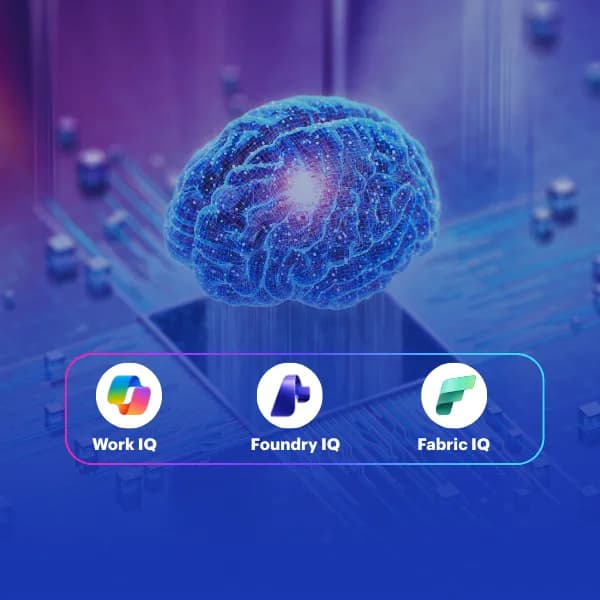
- A shared intelligence layer, through Fabric IQ, that aligns data meaning, business context, and AI reasoning across workloads.
The difference is not cosmetic. By consolidating the value chain — from ingestion to visualization and machine learning — Fabric shifts enterprises from a patchwork of tools to a connected digital nervous system that scales with business priorities.
Why Enterprises Need Data Modernization
The case for change is not academic — it is financial, operational, and existential.
- Speed as a competitive weapon: In dynamic markets, delayed insights equal lost opportunities. As enterprises move toward real-time analytics and AI-assisted decision-making, delays caused by fragmented data pipelines and inconsistent semantics increasingly limit responsiveness.
- Cost simplification: Most organizations maintain five or more platforms — ETL tools, warehouses, lakes, BI systems, and ML environments. Integration and duplication drive cost overruns.
- Compliance as strategy: With GDPR, HIPAA, and India’s DPDP Act, poor data controls expose firms to regulatory and reputational risk.
Simply put, data sprawl is killing innovation. What enterprises need is not another tool, but a unified operating model for data and intelligence, where data, analytics, and AI evolve on a shared, governed foundation.
Microsoft Fabric: The Backbone of an Enterprise Data Strategy
Microsoft Fabric answers that call. It consolidates what enterprises have long tried to stitch together: ingestion, storage, transformation, analytics, AI, and governance.
At its core is OneLake, a single logical data lake for the entire organization. Data is stored once, governed centrally, and accessible to all authorized workloads. This eliminates redundancy, enforces consistency, and lowers costs.
But Fabric goes far beyond storage—it delivers a complete, end-to-end data journey, mirroring the way information naturally flows through an enterprise, from ingestion to insight to action.
How Fabric Powers the Enterprise Data Journey
1. Data Factory (Ingestion & Orchestration)
Enterprises pull data from numerous sources — ERP, CRM, IoT, external feeds. Data Factory makes sure all of it connects seamlessly, with both easy low-code options and advanced orchestration for complex pipelines.
2. Synapse Data Engineering (Transformation & Preparation)
Raw data has little value until it is refined. Synapse Data Engineering enables enterprises to clean, enrich, and model data at scale — without the delays and risks of shifting across systems.
3. OneLake (Unified Storage)
At the center is OneLake, a single, governed repository for enterprise data. By storing everything once in an open format and aligning it through Fabric IQ’s shared semantic context, OneLake ensures consistency, eliminates silos, and reduces duplication.
4. Synapse Data Warehouse (Structured Storage)
For structured, relational data, Synapse Data Warehouse delivers cloud-scale SQL analytics. It combines the trust of traditional warehousing with the speed and elasticity of modern cloud architecture.
5. Real-Time Intelligence (Streaming & Events)
Real-Time Intelligence processes streams from IoT devices, transactions, and applications instantly — powering use cases like fraud detection, personalization, and predictive maintenance.
6. Power BI (Analytics & Visualization)
Insights matter only when they inform decisions. Power BI makes this possible by delivering dashboards, reports, and Copilot-assisted natural-language queries directly where business users already work.
7. Data Activator (Automation & Action)
Fabric turns intelligence into action. With Data Activator, enterprises can trigger alerts, workflows, or automated responses at the very moment a data event occurs.
Intelligence and Governance: Woven Through Every Layer
Unlike the other components, Fabric IQ, Copilot and Governance are not standalone stages — they run through the entire Fabric experience. Fabric IQ ensures that business meaning remains consistent across the platform. It functions as a shared intelligence layer, aligning core definitions and context across OneLake, analytics, Power BI, and AI experiences. Copilot is embedded within each workload, helping users build pipelines, model data, query in natural language, or design reports with ease. Governance, meanwhile, underpins the entire system, ensuring security, compliance, and consistent policies no matter where data flows.
Together, they ensure that Fabric is not just a collection of tools, but a cohesive, intelligent platform where insights are both accessible and trustworthy.
Building an Enterprise Data Strategy: From Vision to Execution
Adopting Fabric — or any modern approach — requires more than technology. Enterprises succeed when they follow a measured roadmap:
- Diagnose the Current State – Map existing pipelines, costs, and pain points. Identify redundancies and compliance gaps.
- Define Outcomes – Is the priority faster reporting, predictive analytics, or frontline AI enablement? Align technology to business goals.
- Adopt Incrementally – Start with one domain (finance, sales, supply chain). Prove value quickly, then scale.
- Embed Governance Early – Classify sensitive data and enforce policies from the start. Governance must be cultural, not compliance driven.
- Scale with AI in Mind – Ensure every new dataset is designed to be Copilot-ready and consumable by ML models.
The Microsoft Fabric Advantage for Future-Forward Enterprises
When evaluating unified data platforms, the real differentiators are not features, but the operating model. Now, with Fabric IQ, this shifts from managing data to enabling intelligence at scale.
Fabric offers exactly that:
- A single logical lakehouse in OneLake.
- End-to-end workloads spanning ingestion to BI.
- Embedded governance and security across the full data lifecycle.
- AI-native design, with shared intelligence through the Fabric IQ to support Copilot and generative AI.
- Lower total cost of ownership through consolidation.
For enterprises, Fabric is not just a modernization path. It is the data intelligence backbone needed to compete in an AI-driven economy.
Closing Perspective: Data as the Fuel of Intelligent Enterprises
As leaders, we must recognize that competitive advantage no longer comes from data alone, but from the intelligence built on top of it.
Modern data engineering is hence not about pipelines and platforms. It is the discipline that enables data intelligence. The enterprises that succeed in the next decade will be those that treat this intelligence layer as a strategic differentiator, not a support function.
With Microsoft Fabric, enterprises now have an architecture that brings data, governance, and intelligence together. Supported by a shared intelligence layer, Fabric aligns analytics, AI, and business context, enabling insights-driven decision-making, predictive analytics, and enterprise-wide intelligence at scale.
The question before us is not if we build a strong data intelligence foundation — it is how quickly we act. At Alletec, we believe the time is now.