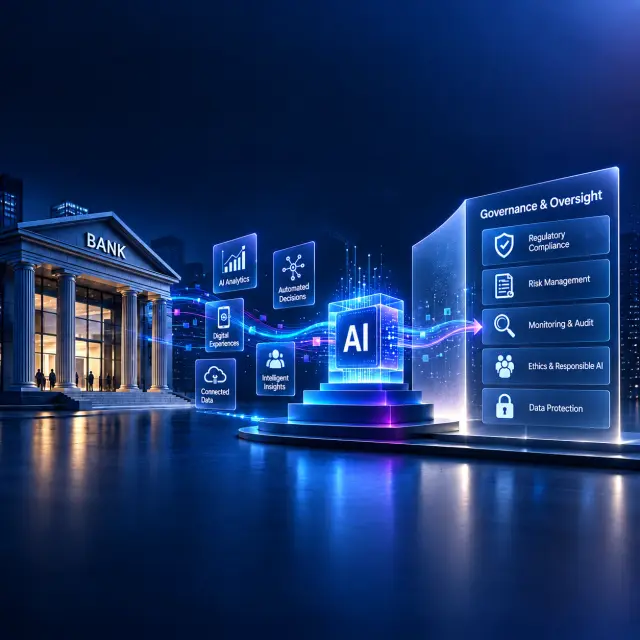
For the last few years, AI has been sold as possibility. Today, it is being judged on outcomes. Boards are no longer asking, “Do we have an AI strategy?” They are asking, “What value has AI actually delivered?” And in many organizations, the answer remains uncertain, fragmented, or at best—early. According to IDC research, organizations using AI at scale report up to 10.3x return on investment, multiplied revenue impact, and significant cost reductions.
This is the defining paradox of enterprise AI today: ambition is everywhere, but value is not. Organizations have invested aggressively in AI platforms, pilots, and proof-of-concepts. Yet very few have translated these into sustained, enterprise-wide business outcomes that move the needle on revenue, margins, or customer experience.
This is not a failure of AI technology. Technology is more capable than ever. The failure lies in how organizations are approaching AI.
The Real Gap: Why AI Ambition Does Not Translate into Value
Most organizations are still treating AI as something to experiment with, rather than something that reshapes how work gets done. That disconnect is what creates the gap between ambition and value. And while the intent is strategic, the failure points are surprisingly operational.
Five Systemic Causes of the AI Value Gap
- AI Without Business Anchoring: Many initiatives start with curiosity around technology rather than clarity on business outcomes such as cost reduction, revenue growth, or cycle time improvement.
- Fragmented Use Case Discovery: Organizations struggle to identify and prioritize high-impact use cases, leading to scattered pilots that never scale.
- Data That Is Not AI-Ready: AI depends on reliable, connected, and governed data. Poor data quality undermines trust and limits effectiveness.
- AI Outside the Flow of Work: If AI requires users to step outside their daily systems, adoption remains low and inconsistent.
- Underinvestment in Change Management: AI transformation is as much about people and processes as it is about technology.
These challenges are structural, not technical. Until they are addressed, even the most advanced AI tools will fail to deliver meaningful ROI.
The Shift: From AI Capability to AI Operating Model
Organizations that are succeeding in scaling AI in enterprise environments are making a fundamental shift. They are not asking, "What can AI do?" They are asking, "How should work change because AI exists?"
This reframing is critical. It transforms AI from an experimental capability into an operating model that reshapes decisions, workflows, and execution.
AI becomes embedded into the way work happens—not an external tool, but an internal force multiplier.
Building an AI-Powered Operating Model with Dynamics 365: Embedding AI Where Work Happens
Microsoft Dynamics 365 represents a shift that most organizations have been inching toward but rarely achieve on their own. AI is no longer positioned as a separate initiative or a parallel experiment. It is built directly into the core business applications that teams already use across Sales, Finance, Supply Chain, Customer Service, Field Service, and Marketing.
This has profound implications. Users are not asked to learn a new system or step into a different environment. Rather, they can use AI within their existing workflows and make decisions in context of work that they are doing already.
And that is what drives real usage. Because adoption does not come from awareness. It comes from relevance.
Copilot in Dynamics 365: The Emergence of the AI Assistant
Copilot fundamentally changes how users interact with enterprise systems. It introduces AI as a collaborator—an intelligent assistant embedded directly into workflows.
Instead of navigating systems manually, users interact with AI in natural language and receive contextual assistance in real time.
In practice, this looks like:
- Sales teams working with real-time opportunity insights, pipeline summaries, and AI-assisted communication drafts that are grounded in actual CRM context
- Finance teams automating reconciliation, identifying anomalies, and generating clear explanations for variances without digging through multiple reports
- Customer service agents receiving instant case summaries, response suggestions, and relevant knowledge, reducing handling time and improving consistency
- Marketing teams building campaigns, drafting content, and designing customer journeys using simple prompts instead of complex configurations
The impact is significant.
AI and copilots reduce cognitive load by removing the need for users to navigate systems manually. This accelerates decision-making because users receive insights in context. Organizations ensure more consistent execution by guiding and standardizing recommendations.
AI Agents in Dynamics 365: From Assistance to Autonomous Execution
While Copilot enhances human productivity, AI Agents take the next step. These agents are not experimental bots or isolated automations. They are designed to handle specific business processes end-to-end, operating within defined rules and workflows.
They move AI from assistance to execution. Here are some out-of-the-box AI agents that simplify business processes:
| Dynamics 365 Product | AI Agents Available |
|---|---|
| Business Central |
Payables Agent – processes invoices from ingestion through to posting, reducing manual intervention across accounts payable Sales Order Agent – converts unstructured customer communication into structured transactions, bridging the gap between emails and system entries |
| Finance |
Account Reconciliation Agent – automates multi-system comparison, identifies mismatches, and executes reconciliation workflows. Variance Analysis Agent – reviews variances vs. budget/forecast, identifies outliers, and produces commentary. Collections Agent – prioritizes receivables, initiates follow-ups, and helps maintain cash flow discipline |
| Customer Service |
Case Management Agent – manages customer service workflows, ensuring consistency and speed in issue resolution Customer Intent Agent – uncovers customer intent from every interaction to enable precise routing, smarter self-service, and superior customer experiences with minimal administrative overhead. Customer Knowledge Management Agent – transforms cases, conversations, emails, and notes into high-quality knowledge articles automatically—empowering agents with instant answers and delivering consistent, reliable service. Quality Evaluation Agent – evaluates conversations using AI to score performance, uncover insights, and deliver scalable, unbiased coaching—without manual quality reviews. |
| Supply Chain / Procurement | Supplier Communication Agent – handles vendor interactions, confirmations, and updates without requiring constant manual oversight |
| Sales & Project Operations |
Sales Qualification Agent (Research-only / Research & Engage) - supports lead qualification by researching prospects, assessing fit against target customer profiles, and preparing outreach recommendations. In Research & Engage scenarios, it can assist with drafting and sequencing emails and hand over high-intent leads to sellers, helping sales teams focus on the most promising opportunities Sales Close Agent – Research - brings together CRM data, emails, meetings, and web insights into a consolidated view, while highlighting potential risks and recommended next steps. Sales Close Agent – Engage - designed for high-velocity and lower-complexity deals, this agent assists with outreach and follow-ups, supports guided self-serve experiences, and escalates to a seller when human interaction is required. |
This eliminates one of the biggest barriers to AI adoption: use case discovery. Organizations no longer need to ask where AI can be applied. The use cases are already embedded into the system, aligned to real business processes. This removes one of the biggest barriers to adoption. Instead of asking “where should we use AI?”, organizations can move directly to “how do we activate and scale what is already available?”
And that shift, from discovery to execution, is where AI finally starts delivering value.
Microsoft 365 Copilot: AI Across the Enterprise
AI does not stop at ERP and CRM. Microsoft 365 Copilot extends AI into everyday work—documents, meetings, emails, and collaboration.
This creates a unified experience where AI supports every layer of work—from strategy to execution.
With emerging multi-agent collaboration models, AI is evolving from assistant to collaborator—working alongside teams, connecting insights across systems, and enabling faster, better decisions.
The Economics of AI in Dynamics 365: Lower Risk, Faster Time-to-Value
Another critical advantage of the AI-first operating model is economic. Many Copilot capabilities are included within existing Dynamics 365 licenses. This dramatically reduces the barrier to entry.
Organizations can begin their AI journey without large upfront investments. They can experiment in a controlled manner, validate outcomes, and scale usage based on value realization.
This shifts AI from a speculative investment to an operational capability with predictable ROI.
From Standard to Strategic: Leveraging AI in Dynamics 365 Beyond Standard Capabilities
As organizations mature their AI operating model, they move beyond out-of-the-box capabilities to build differentiated AI solutions that create competitive advantage.
- Copilot Studio enables creation of custom AI agents aligned to business workflows
- Microsoft AI Foundry provides enterprise-grade orchestration, governance, and scalability
- Integration with data platforms enhances contextual intelligence
The Emergence of the AI-Powered Frontier Firm: A New Enterprise Model
As these capabilities come together, a new type of organization begins to emerge.
- Decisions are AI-augmented
- Processes are AI-driven
- Teams are AI-enabled
- Systems are AI-native
These organizations are not experimenting with AI. They are operating with AI. And this creates a sustained competitive advantage.
The New Playbook for AI Value
To move from ambition to value, organizations must adopt a new playbook:
- Start with business workflows, not technology
Map where work slows down, breaks, or leaks revenue. Then apply AI there. - Embed AI where work already happens
Adoption follows naturally when AI fits into existing systems and processes - Use pre-built agents before building custom solutions
Value comes faster when you activate what already exists - Invest in adoption and change management
AI only delivers impact when people understand, trust, and use it responsibly - Measure outcomes and scale what works
Set clear goals, test AI in small use cases, and expand the ones that show real improvement in time, cost, or revenue.
The Alletec Perspective: Turning AI into Outcomes
At Alletec, we believe AI value is unlocked through disciplined execution. Technology provides the foundation, but outcomes depend on how effectively it is operationalized.
How Alletec Enables AI Value Realization for Dynamics 365 Customers
- Identify high-impact opportunities aligned to business outcomes
Instead of starting with tools, the focus is on identifying where AI can move the needle in measurable ways. This could reduce cycle times in finance, improve conversions in sales, or accelerate response times in customer service. The goal is to anchor AI in outcomes, not experimentation. - Configure Copilots and Agents for real-world workflows
Out-of-the-box capabilities are powerful, but they still need to be aligned to how your business operates. Copilots and AI agents are configured within actual workflows, so they support decisions and actions, rather than sitting as features that are technically enabled but rarely used. - Enable users through structured training and adoption programs
Adoption does not happen because a feature exists. It happens when users understand when to use it, why it helps, and how it fits into their daily work. This requires role-based training, real use case demonstrations, and ongoing support, not just a one-time walkthrough. - Extend capabilities using Copilot Studio and AI Foundry
As organizations mature, standard capabilities are extended to fit more specific needs. Custom agents and workflows can be built using Copilot Studio and AI Foundry, allowing AI to reflect business-specific logic rather than generic patterns. - Continuously measure and optimize business outcomes
AI adoption is not a one-time event. It requires continuous monitoring of usage, performance, and impact. What is working gets scaled. What is not gets refined. This is how AI moves from isolated wins to consistent, enterprise-wide value.
This is the approach behind Alletec's Copilot & AI Agents Adoption Pack—a structured engagement that compresses the readiness-to-activation cycle from months to weeks, with measurable outcomes typically visible in 60-90 days.
Explore Copilot and AI Adoption Pack
The AI Race Has Already Begun. Are You Winning or Losing?
The AI conversation has moved on. It is no longer about who is investing in AI. It is about who is extracting value from it. The winners will not be those with the largest budget. They will be those who embed AI into their operations, drive adoption across teams, and scale outcomes systematically. The tools are ready. The capabilities are proven.
The only question that remains:
How quickly can you turn AI ambition into a measurable business value—and evolve into a Frontier Firm?