

Data engineering is about building a foundation for reliable analytics and AI.
Alletec helps you:

“The Microsoft Fabric Data Platform has transformed our reporting and analytics. We no longer face ERP refresh limitations and now have real-time insights across systems. This foundation positions us to leverage AI and advanced analytics for future community impact.”Kerry Bird, One FoundationRead Full Case Study
The most common data infrastructure challenges that organizations face include:
Disconnected systems that require constant manual intervention for data integration. This means - different teams are likely working from different versions of the truth.
Inconsistent and/or incomplete data impacts decision-making. Analysts often end up spending 60 to 80% of their time just on data preparation that they can use for analysis.
Legacy infrastructure begins to crack when data volumes grow rapidly. This becomes a major roadblock in the adoption of AI and advanced analytics.
Data related issues naturally result in significant delays. This impacts the ability of the business to leverage opportunities and becomes a competitive disadvantage.
We help organizations with secure and automated ingestion of data from diverse organizational data sources - ERP, CRM, SaaS platforms, databases, files, APIs, and event streams - into a unified data environment.
Quicker onboarding of new data sources
Reduced manual data movement
Consistent and repeatable ingestion processes
We transform raw data into structured business-ready datasets. They are aligned to reporting, analytics, and AI needs, so the business is working from a single reliable version of the truth.
Consistent KPIs and metrics
Reduced reconciliation and reporting errors
Data business leaders and AI can rely on
We design and implement scheduled batch pipelines and real-time streaming pipelines based on business responsiveness requirements.
Near real-time operational visibility
Faster response to business events
Support for event-driven use cases
We enable orchestration, monitoring, alerting, and recovery mechanisms. This ensures that data pipelines run reliably.
Reduced data delays and broken dashboards
Faster issue detection and resolution
Lower operational and compliance risk
Alletec’s data engineering services form the foundation for:
By ensuring data is accurate, timely, and governed, we help organizations move analytics and AI initiatives from pilots to production.
ERP and IoT data pipelines bring production and supply chain analytics together. This gives teams visibility into integrated operations like - what is running, what is delayed, which machines are at risk. This can create a foundation for predictive maintenance.
Sales, inventory, and pricing data pipelines provide near real-time demand visibility - across stores and channels. It enables unified channel analytics to show what is selling, what is running out, and what actions are needed to prevent revenue leaks.
Financial and transaction data consolidation brings all critical numbers into one place. This creates a traceable pipeline which is audit-ready and can be relied upon by finance and operations. This becomes the basis for Risk and Performance analytics.
Project, billing, and utilization data pipelines feed unified operational and financial reporting. This enables building an understanding of the project and the business. project status, how much is being invested, what is being billed, and where margins or capacity are becoming a cause of concern.
Data Engineering requires built in processes and technology for quality, security, and governance. Our pipelines include:
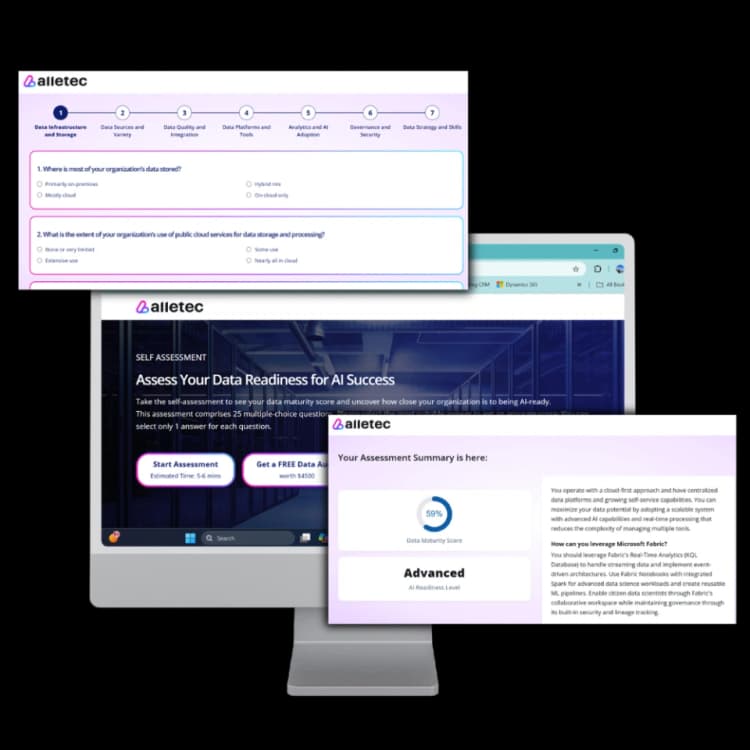
Take the self-assessment to see your data maturity score and uncover how close your organization is to being AI-ready
Alletec’s data engineering practice combines Microsoft platform expertise with battle-tested methodologies. We deliver solutions that are production-ready and scalable.

Data engineering is the practice of building and managing data pipelines that move data from source systems into analytics and AI environments. This includes integrating data from multiple systems, cleaning and transforming it, and structuring it in data lakes and data warehouses so it is reliable, governed, and ready for use.
 Ask me anything