


Microsoft Data Fabric brings operational data, analytics, real-time intelligence, semantics, governance, and AI together on one SaaS platform built on OneLake, so organizations can become insight-driven, AI-first, and operationally intelligent.
Traditional data platforms were built for storage and reporting. That model no longer fits how modern organizations operate. Reality That Enterprises Face Today:

“The Microsoft Fabric Data Platform has transformed our reporting and analytics. We no longer face ERP refresh limitations and now have real-time insights across systems. This foundation positions us to leverage AI and advanced analytics for future community impact.”Kerry Bird, One FoundationRead Full Case Study
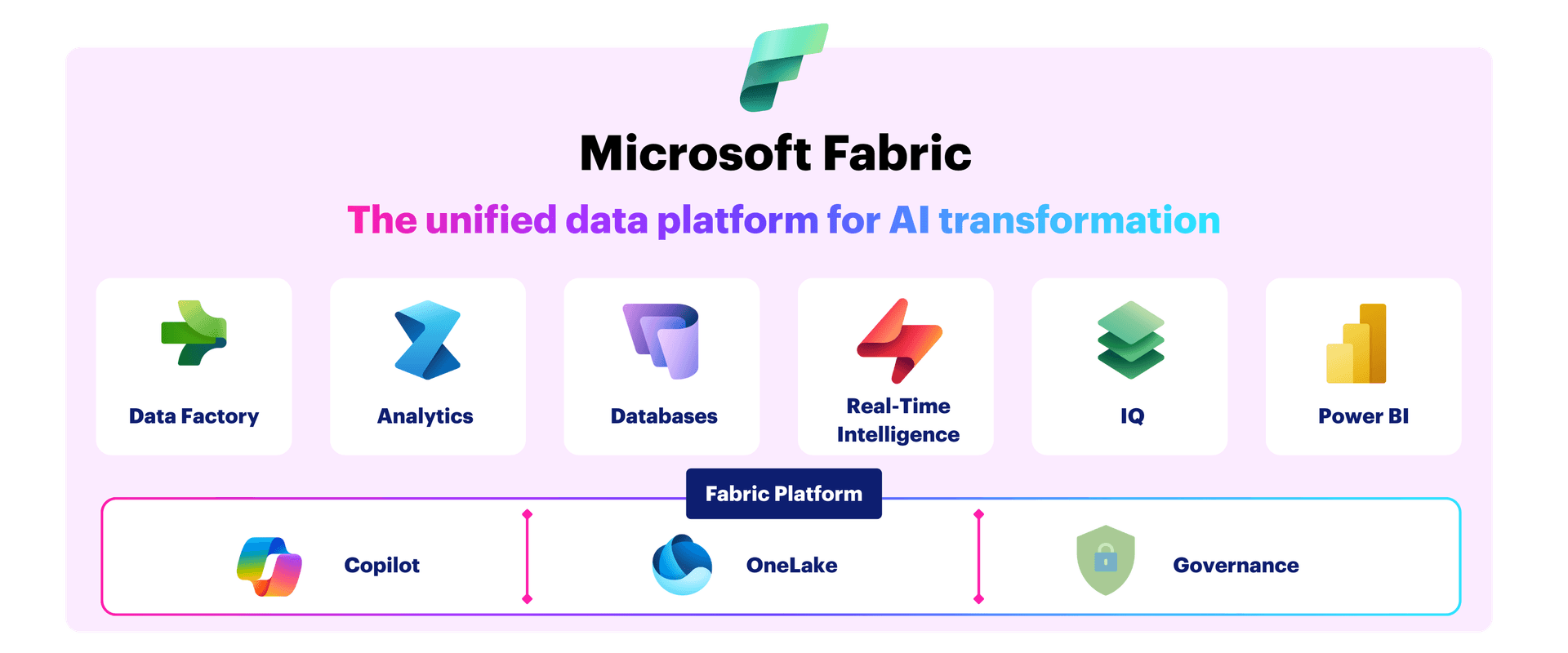
Fabric is built on OneLake as a single enterprise data plane. On top of this operate:
It is a single logical lake for the entire enterprise. Supports Delta/Parquet, shortcuts, and zero‑ETL mirroring. This eliminates data silos and duplication.
Support Spark pipelines, medallion architecture, feature engineering, batch and streaming transformations.
The workloads provide streaming ingestion, KQL queries, anomaly detection, and operational dashboards.
Introduced at the Ignite 2025 - Fabric Databases like SQL ad Cosmos DB enable translytical architectures. This makes it possible for operational and analytical workloads to coexist. One can now build AI‑ready apps that run with Databases in Fabric. There’s a Data warehouse with Enterprise SQL analytics with Direct Lake, T‑SQL, materialized views, and BI acceleration.
Fabric IQ introduces a semantic layer with enterprise ontology. It also provides graph reasoning, and intelligence driven by data agents and operations agents.
Copilot embeds generative AI across engineering and analytics. This provides capabilities for natural language query, pipeline generation, semantic exploration, AI-assisted modeling and monitoring.
This Provides Catalog, lineage, classification, sensitivity labels, access policies, audit, and Responsible AI foundation.
Ignite 2025 saw Microsoft make significant announcements. Here’s a summary of new releases on Fabric:
(Operational SQL/NoSQL)
Brings operational databases (Azure SQL Database and Cosmos DB) into the Fabric platform as fully managed, serverless services. Data is instantly available in OneLake for analytics (translytical processing), with support for relational and NoSQL workloads, vector search, and integration with Fabric’s security and governance.
Unifies transactional and analytical data on one platform – no lengthy ETL needed. This accelerates app development and analytics on the same data set., Architecture complexity is reduced, and real-time insights can be made available from operational data. Developers access enterprise-grade databases on-demand, which are fully secure and scalable, directly within the analytics ecosystem.
(Semantic Intelligence)
Introduces a unified ontology and semantic modeling layer for enterprise data. Allows definition of business entities, relationships, and metrics beyond individual datasets, creating a common language for data across the organization. This includes AI-powered Data Agents to answer natural language questions using this model, and Operational Agents to monitor live data and trigger actions, leveraging a built-in graph engine for reasoning.
Establishes a single source of truth for business definitions and metrics. It improves data consistency and trust and makes analytics and AI more accessible – users can ask business questions in natural terms and get context-aware answers. Enables proactive operations (through autonomous agents reacting to data in real time), driving faster decision-making and automation of routine tasks. Overall, boosts AI readiness by providing context that AI models and assistants require for accurate insights.
(Generative AI Assistance)
Embeds Microsoft’s Copilot (GPT-powered assistant) throughout Fabric’s user experience. Users can use natural language prompts or chat to generate data pipelines, code, queries, or visuals. Copilot can suggest transformations, correct formulas, and explain what the results mean. All the while operating with awareness of the user’s data context. For example, ask Copilot to “create a sales dashboard” or “find anomalies in IoT sensor data,” and it will help produce the required analytics artifacts.
Greatly lowers the skill barrier and increases productivity. Business users and data analysts can accomplish complex data tasks without deep technical coding, by simply conversing with the AI assistant. This shortens development cycles because the AI can draft pipelines or SQL in seconds, and it helps teams learn by giving real-time guidance. It also encourages wider use of the data platform, since users can get value through easy Q&A and iterative exploration, leading to more agile decision-making.
(OneLake Shortcuts & Mirroring)
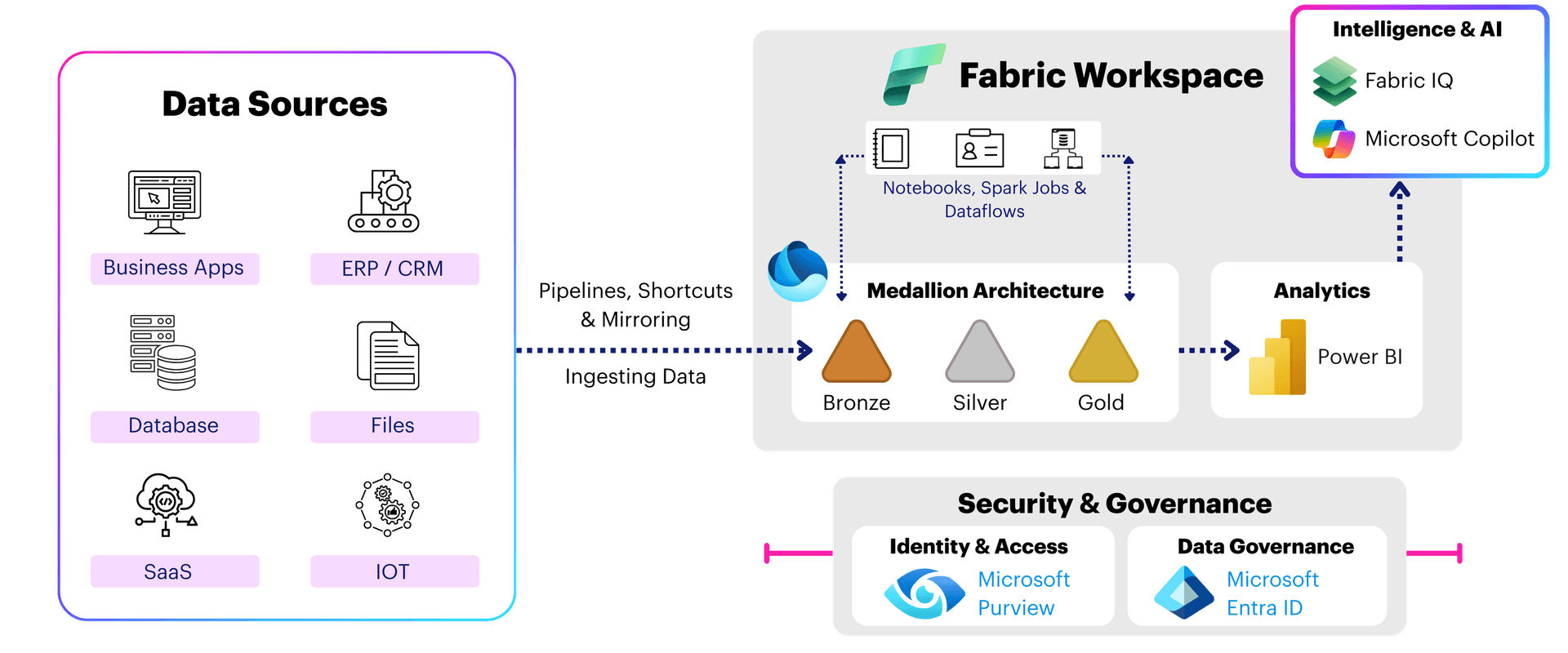
New integration features that let Fabric ingest and unify data from disparate sources with minimal effort. OneLake Shortcuts allow direct linking to external data repositories (like SharePoint, Snowflake, Azure Data Lake, etc.) without moving data. Database Mirroring for Azure SQL, SQL Server, Cosmos DB, PostgreSQL and more keeps operational data continuously in sync with Fabric’s OneLake. All data – whether in cloud storage, legacy databases, or SaaS apps – can be unified in Fabric’s lakehouse architecture in near real-time, without building custom ETL pipelines.
Eliminates traditional data silos and latency. Companies get a unified, up-to-date view of all their data across systems enabling integrated analytics. This reduces IT overhead and complexity by doing away with many ETL jobs and data duplication. Decisions can be made on fresh data from across the business, improving responsiveness (e.g. if a transaction happens in a CRM or ERP system, it’s available in Fabric for reporting or AI models almost immediately). This connectivity also future-proofs the data estate – as new data sources come online, they can be linked or mirrored into Fabric quickly, accelerating time-to-insight for new initiatives.
AI only works when the data underneath it is clean and connected.
Fabric is designed to support AI, copilots, and autonomous agents by providing:
Fabric is designed to be the data foundation for:
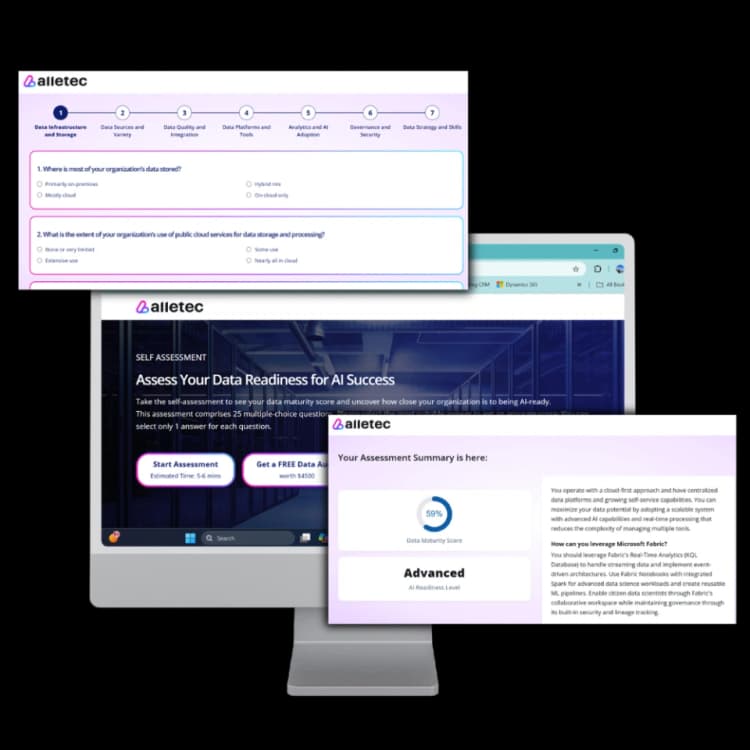
Take the self-assessment to see your data maturity score and uncover how close your organization is to being AI-ready
Microsoft Fabric is built to work across industries, from SMBs to enterprises. Some use cases for Fabric include:
Banks and insurance companies use Fabric to unify data from core banking/ operational systems, customer interactions, and external systems/ market feeds. Fabric-powered lakehouse enables them to get a 360° view of customers and risks. This enables advanced analytics. Important functions like fraud detection, real-time portfolio risk analysis, and accurate financial forecasting become available. And all happens under strict governance that meets compliance requirements such as GDPR and Basel rules.
Retailers leverage Fabric to integrate point-of-sale data, e-commerce transactions, supply chain information, and customer demographics into OneLake. This single data source drives omni-channel analytics – from real-time inventory optimization to personalized marketing. Power BI dashboards built on Fabric help retail managers track sales performance across stores and online in near real time. At the same time AI models forecast demand and personalize promotions. This helps boost sales and customer satisfaction.
Manufacturing companies can collect massive IoT data from machines and production lines. Fabric’s real-time analytics and AI capabilities enable predictive maintenance and quality control. For instance, sensor data from factory equipment can stream into Fabric; anomalies are detected immediately via Data Activator alerts, preventing costly downtime. Meanwhile, engineers and analysts can merge operational data with supply chain and ERP data in the lakehouse to optimize the end-to-end production process - improving efficiency and reducing costs.
Hospitals and healthcare providers can use Microsoft Fabric to break down data silos between electronic health records (EHR), lab systems, and patient experience apps. OneLake holds this diverse data in a compliant manner. This helps Analysts derive population health insights, and doctors can get AI-driven clinical decision support. Patient data remains governed and privacy protected. Fabric’s unified governance (with Purview integration) also helps healthcare organizations ensure HIPAA compliance and secure sensitive patient information.
Consulting and services organizations benefit from Fabric by consolidating operational data from projects, resource management, and financials. They can analyze project performance and profitability across the firm with Power BI and use AI to forecast resource needs or project outcomes. The single data platform improves knowledge sharing and IP reuse.
Microsoft Fabric is powerful. But without the right architecture, governance, and way of running it, even the best data fabric solutions quickly turn into just another platform. Alletec brings deep technical skills and real industry experience to make sure Fabric delivers real value for your business. Here’s why teams choose to work with us:
Alletec helps organizations build Microsoft Fabric services as a strategic intelligence platform. We bring Microsoft Fabric engineering, governance-led architectures, AI and Copilot readiness, and end-to-end delivery from strategy to scale.
Data, AI, and governance maturity
Fabric-first reference architecture and roadmap
Lakehouse, Warehouse, Real‑Time, Databases, Semantics
Copilots, AI models, Agents, Self‑Service Analytics
Purview, Security, Responsible AI
Managed services and continuous optimization

 Ask me anything