Demand forecasting is getting harder
A Gartner survey of 258 procurement leaders found that 42% rank supply disruption as their top threat to future success. The drivers are familiar i.e. trade shifts, freight delays, weather disruption, and changing consumer habits have all made demand harder to predict.
Every supply chain decision starts with a forecast. When the forecast is off, stock piles up, products run out, freight costs spike, and revenue slips.
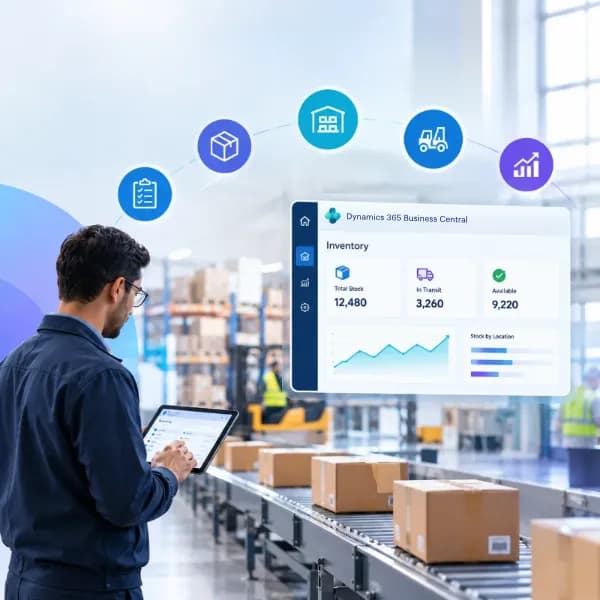
Microsoft is targeting this gap with the Demand planning app inside Dynamics 365 Supply Chain Management.
What is the Microsoft Dynamics 365 Demand Planning App?
Demand planning in Dynamics 365 Supply Chain Management is Microsoft's collaborative planning app. It uses AI to find patterns in past sales data and predict future customer demand. Planners don't need to write code or build models from scratch.
The app comes with four built-in forecasting models:
- Auto-ARIMA (Autoregressive Integrated Moving Average): good for stable, predictable demand patterns.
- ETS (Error-Trend-Seasonality): handles clear trends and seasonal swings.
- Prophet: built for messy, real-world demand data.
- XGBoost (Extreme Gradient Boosting): factors in outside influences like promotions, weather, or events.
Planners don't have to pick the right model themselves. A best-fit option evaluates each product and selects the strongest match automatically. For unusual products, teams can plug in their own custom models built on Azure Machine Learning. Automatic AI tuning handles model setup in the background, saving planners hours each cycle.
Beyond the models, the app also covers day-to-day planning:
- External signals like promotions, stockouts, and market data feed straight into the forecast.
- Rolling plans keep the forecast updated as new data comes in.
- New product introduction support handles launches and product retirements without skewing the data.
- Role-based access lets different teams own different parts of the plan.
Everything runs on a no-code interface, so planners spend less time wrestling with software and more time on judgment calls.
How does Copilot in the Dynamics 365 Demand Planning App help planners?
Copilot in Demand planning is the AI assistant inside the app. Planners click any cell on the forecast worksheet, ask in plain English what's going on, and Copilot returns a short summary and a visual ranked by importance. Every answer is tied to that exact cell, so planners can point to specific signals that moved the forecast for that SKU, region, time period, or customer segment.
Out of the box, Copilot handles:
- Period-over-period analysis: what changed between this month and last month, or between this month and the same month last year.
- Trend detection: directional changes across the last six periods.
- Anomaly identification: outliers across the calendar year for any product, location, or customer.
- Forecast-versus-actual deviations: where the biggest gaps between predicted and observed values sit.
- What-if scenarios: modelling a 15 percent demand spike, a doubled supplier lead time, a new product launch, or a supplier disruption to see the impact on demand, revenue, profit, and capacity.
What's the real impact of AI-driven demand forecasting?
Research from McKinsey and Gartner points to gains in five areas:
- Sharper forecasts — As per McKinsey operations research, AI-driven models reduce supply chain forecast errors by 20 to 50 percent, giving every downstream planning decision a more reliable starting point.
- Higher product availability — The same study links AI forecasting to up to 65 percent fewer lost sales and product unavailability incidents, which translates into fewer empty shelves and fewer last-minute freight scrambles.
- Lower operating costs — Warehousing costs drop 5 to 10 percent and admin costs drop 25 to 40 percent (also McKinsey operations), trimming both fixed overhead and the manual planning work that eats into margin.
- Leaner inventory — A separate McKinsey distributor study finds AI forecasting and inventory optimization can reduce inventory levels by 20 to 30 percent, freeing working capital and easing warehouse pressure.
- Top strategic priority — A Gartner survey ranks AI and agentic AI as the biggest driver of supply chain performance over the next two years, putting demand forecasting at the center of supply chain investment plans.
How AI-driven demand forecasting shapes day-to-day supply chain decisions
AI-driven demand forecasts shape the decisions supply chain leaders and CIOs make every week. The biggest shifts show up in five areas:
- Inventory and working capital — Planners set safety stock policy against forecast uncertainty. As the AI forecast tightens accuracy, they can safely reduce safety stock levels across the network, which frees up working capital and the warehouse space tied up in slow-moving inventory.
- Stockouts and lost sales — Forecast errors usually surface as empty shelves and expedited freight to refill them. A sharper AI forecast catches demand shifts earlier, so distribution and replenishment plans stay ahead of actual sales, reducing both stockouts and the unplanned freight that follows.
- Procurement timing — Procurement teams work on lead times that often run longer than the demand signals they receive. With an AI-driven forecast that updates as real signals arrive, procurement gets earlier visibility into what's coming, which means more time to lock in better prices and reduce dependence on rush shipments or single suppliers.
- Production scheduling — Manufacturing leaders set production plans against lead times that span weeks. When the demand forecast updates with current signals, capacity and resource plans adjust against the latest view, reducing both overproduction and the last-minute rescheduling that disrupts the shop floor.
- Sales and operations planning — The S&OP cycle has historically run on multiple disconnected forecasts as different functions adjust the number for their own reasons. With one shared AI-driven forecast and Copilot explaining what's changed and why, business teams come to the cycle aligned around the same number, and decisions land faster.
How Alletec helps you put AI-powered demand forecasting to work
As a Microsoft Dynamics 365 implementation partner, Alletec helps enterprises adopt and scale AI-powered demand forecasting end to end. The work covers data readiness, model selection, Copilot rollout, and the change management that decides whether planners trust the forecast. We work with teams already on D365 Supply Chain Management as well as those moving in from older ERP systems.