The manufacturing industry in USA is entering a growth cycle that looks fundamentally different from the ones that came before it. The ISM Manufacturing PMI, a monthly economic indicator for the US manufacturing sector, has been signaling expansion since early 2026. Factory construction, reshoring incentives, and semiconductor investment are pulling production capacity back onshore at a pace the industry hasn’t seen in decades.
In previous expansion cycles, growth was labor-led. Manufacturers hired more people, added shifts, and scaled output by putting more hands on the floor. That playbook no longer works. The labor market has structurally changed. A Deloitte and Manufacturing Institute study projects that US manufacturing could need 3.8 million new workers by 2033, with up to 1.9 million of those positions going unfilled. The workers who retire take institutional knowledge with them. The workers who replace them, when they can be found, need months of onboarding before they’re productive.
At the same time, supply chains are shorter but more volatile, customer expectations for speed and customization keep rising, and regulatory requirements continue to grow. Scaling in this environment requires a fundamentally different operating foundation, one where ERP, production data, supply chain planning, and AI capabilities work as a single system rather than as separate tools layered onto existing processes.
Most manufacturers recognize that this shift requires investment. But spending alone isn’t enough A 2026 Global AI Report found that only 15% of organizations qualify as true "AI leaders." In manufacturing, those leaders achieve results not by spreading AI broadly, but by concentrating where it can reshape core workflows and scale across plants and value chains. 93.2% of AI leaders in manufacturing use AI to support back-office and mid-office workflows, such as operations management, planning and engineering, compared with 68.8% among laggards, who are more likely to apply AI selectively, limiting their ability to drive sustained operational improvement.
It’s evident that, for most manufacturers, the needed investment is landing in pockets rather than transforming how the operations actually run. That disconnect between spending and outcomes is the central challenge we will address in this playbook.
Why Smart Manufacturing Investment Is Outpacing Factory Floor Results
Manufacturers see smart manufacturing as one of the biggest drivers of competitiveness over the next three years, and 88% expect their spending on it to stay the same or increase, according to Deloitte. The investment reflects that confidence. The problem is that much of it is happening in pockets rather than changing how the operation works as a whole.
You can trace the pattern across almost every function.
A sensor network goes live on one production line, but the data never reaches the planning team. An analytics dashboard gets deployed, but remains disconnected from the financial system. A demand planning tool improves forecasting, but isn’t integrated with the ERP. Each investment can deliver value on its own. But when these systems don’t connect, those gains don’t add up across the business.
That disconnect also affects how quickly and accurately decisions get made. If a planner’s updated forecast doesn’t reach procurement in time, purchase orders are based on outdated demand. If supplier commitments don’t automatically update the production schedule, the shop floor ends up working to a plan that no longer reflects reality.
All these create another opportunity for a decision to be delayed or a mistake to creep in. And with experienced planners and operators becoming harder to find and retain, businesses can’t keep relying on the people who know how to bridge these gaps through experience and tribal knowledge. The technology needs to connect these processes on its own.
Building Intelligent Manufacturing Operations: What the Technology Must Deliver
The shift manufacturers need is from a system of records to a connected system that actively shapes what happens next. Production signals, supply chain data, financial controls, and AI-powered analytics all running through one platform where each function sees what every other function sees, in real time. A connected platform can help manufacturers by enabling:
Live production intelligence — Supervisors and plant managers need to see which lines are running, which are idle, and where output is falling behind plan as it happens. Real-time production data replaces shift-end reports, and OEE tracking becomes a live metric rather than a monthly exercise. Job orders, material consumption, and labor allocation get captured at the point of activity, not reconstructed later from paper logs.
Dynamic production planning — Material requirements planning and capacity scheduling have to reflect actual demand, real lead times, and current inventory positions rather than static assumptions from the last planning cycle. When demand shifts, the capacity plan and material requirements recalculate together, giving production and procurement a shared, current view of what needs to happen and when.
Connected procurement — Purchase requisitions, vendor quotes, approvals, and delivery tracking all flow through one system linked to the production plan. When a supplier misses a delivery window, the downstream impact on production scheduling and customer commitments is visible immediately, not after someone checks a spreadsheet and sends an email.
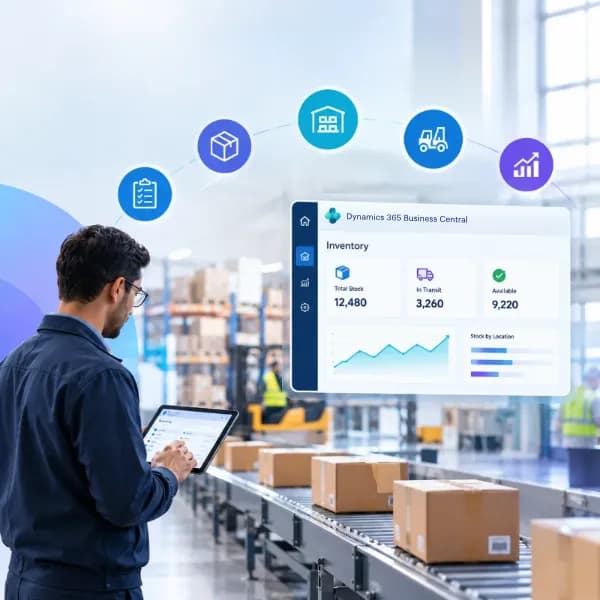
Unified inventory visibility — Raw materials, work-in-progress, and finished goods need a single accurate count across every location. Warehouse operations run faster and with fewer errors when they’re guided by the same system that manages production and sales orders. Distribution planning needs that real-time stock visibility to route shipments efficiently and meet delivery commitments.
Predictive maintenance — Sensor data from connected assets, including vibration patterns, temperature drift, and cycle time anomalies, surfaces early warning signals directly inside the ERP. Maintenance workflows trigger before equipment fails, reducing unplanned downtime and extending asset life. The shift from scheduled or reactive maintenance to condition-based, predictive maintenance remains one of the highest-ROI interventions available on a factory floor.
Accurate demand forecasting — Demand planning moves from spreadsheet-driven estimates to AI/ML models that incorporate sales history, external signals, promotions, and seasonality to make accurate predictions. When the forecast updates, procurement and production schedules adjust against the same data simultaneously, without someone reconciling numbers between departments.
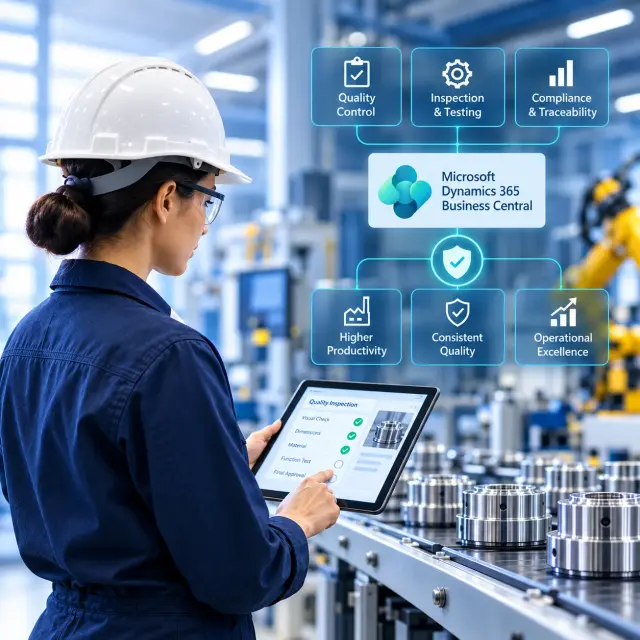
Embedded compliance and safety — Quality outcomes feed directly into the production record so defect patterns trace to a specific machine, shift, or batch. Compliance documentation, safety audits, HSE reporting, and regulatory certifications live inside the operational system rather than in parallel folders and spreadsheets. For manufacturers operating across jurisdictions, the system has to accommodate different regulatory requirements without creating a separate compliance workflow for each market.
The Microsoft Dynamics 365 Platform for Intelligent Manufacturing
Microsoft Dynamics 365 is built to deliver this kind of operating model. Every capability, from production execution and demand planning to warehouse operations, procurement, asset management, and AI, runs on one cloud platform with a single data layer. The production record that the shop floor writes to is the same record finance closes the books against, the same record supply chain plans from, and the same record AI models learn from.
That single-data architecture is what makes Dynamics 365 structurally different from legacy ERP systems or point solutions stitched together. There’s no integration layer to build, no data reconciliation between departments, and no version conflict between what one team sees and what another reports.
Here are some next-gen manufacturing capabilities and features available in Dynamics 365:
Real-Time Production Control and Intelligent Planning
Dynamics 365 Supply Chain Management includes a Production Floor Execution interface that gives workers and supervisors a live view of job orders, material availability, and production progress. Job starts, completions, material consumption, and quality outcomes are captured in real time. The built-in MRP engine calculates material and capacity requirements against actual demand, inventory on hand, and production lead times, and regenerates plans as conditions change. Dynamics 365 Business Central supports production order management, capacity planning, and shop floor reporting within a unified environment suited to mid-market operations. When this production data connects to AI-powered analytics, manufacturers unlock predictive performance capabilities that turn shop floor signals into operational intelligence.
End-to-End Supply Chain Visibility from Procurement to Delivery
Purchase requisitions, vendor selection, purchase orders, and goods receipts run through the same platform that manages production and finance. Dynamics 365 Supply Chain Management includes advanced warehouse management with mobile-guided workflows for receiving, put-away, picking, packing, and shipping. Inventory visibility spans raw materials, WIP, and finished goods across multiple warehouses and locations in real time. For distribution, order promising and transportation management help manufacturers commit accurate delivery dates and route shipments efficiently. Business Central handles core procurement, inventory, and warehouse operations for manufacturers that don’t need the full complexity of the enterprise warehouse module.
IoT-Driven Predictive Maintenance and Asset Intelligence
Through Azure IoT Hub and Azure IoT Central, manufacturers stream real-time sensor data from PLCs, SCADA systems, and connected assets directly into the Microsoft ecosystem. Dynamics 365 supports IoT sensor data intelligence natively, enabling equipment health monitoring, condition-based alerts, and predictive maintenance triggers that feed into asset management workflows. When a motor’s vibration signature drifts or a conveyor’s cycle time creeps above baseline, the system surfaces an alert before a failure occurs.
Copilot-Assisted Demand Planning and Forecasting
The Demand Planning app inside Dynamics 365 Supply Chain Management uses built-in AI forecasting models to find patterns in historical sales data and predict future demand. Copilot adds cell-level explainability, letting planners trace exactly which signals shaped a forecast before acting on it. Planners can ask in plain English what changed, why it changed, and which external factors drove the adjustment. Traceability Copilot, introduced in the 2024 release wave 2 and since expanded, tracks products through production, valuable for quality investigations, regulatory compliance, and root cause analysis.
Built-In Quality, Compliance, and Safety Controls
Dynamics 365 supports quality management processes including inspection plans, non-conformance tracking, and corrective action workflows within the production environment. For manufacturers subject to industry-specific regulations, FDA traceability requirements, export controls, or environmental reporting, the compliance documentation lives inside the same system that runs production and finance. HSE incident tracking, permit-to-work management, and audit documentation can be managed within the platform or extended through Power Platform workflows, keeping safety and compliance integrated with daily operations.
Embedded Real-Time Manufacturing Analytics
Power BI integrates natively with the Dynamics 365 manufacturing platform, enabling embedded OEE dashboards, production performance reports, downtime analysis by line and shift, quality trend tracking, and inventory health monitoring without requiring a separate analytics tool. This enables supervisors to act on what they see in the moment rather than reviewing old reports.
AI Agents and Autonomous Manufacturing Operations
The AI capabilities inside Dynamics 365 go beyond analytics and copilots. At Hannover Messe 2026, Microsoft outlined its direction for agentic AI in manufacturing: AI that doesn't just surface insights but takes action within governed boundaries, helping manufacturers replan faster, make better production tradeoffs, and hold customer commitments as conditions shift.
Several agents are already available or in active rollout. The Supplier Communications Agent handles routine supplier interactions, from purchase order confirmations to shipping updates and invoice matching, so procurement teams can focus on the conversations that actually shape cost and delivery performance. The Procurement Agent in Dynamics 365 Supply Chain Management goes further, helping teams handle supplier exceptions, assess downstream impact on production schedules, and respond to disruptions with speed and context rather than manual triage. For maintenance, the trajectory is toward agents that can initiate work orders, check parts availability, schedule the maintenance window against production capacity, and notify the relevant team, with a human reviewing and approving rather than initiating each step. On the shop floor, AI agents are giving frontline workers real-time guidance, accelerating issue resolution and root cause analysis so that decisions that used to wait for a supervisor or an engineer can happen in the moment.
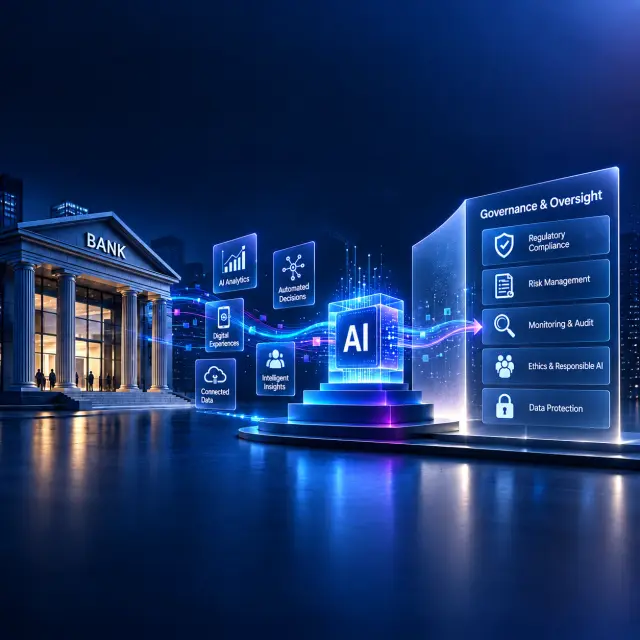
The broader vision extends beyond individual agents to what Microsoft describes as agentic supply chains, where networks of suppliers, plants, and logistics partners are connected by AI agents that continuously scan for change, reason across data, and support action in real time. When a supplier delay hits or demand shifts unexpectedly, these agents don't just flag the disruption. They assess the downstream impact across procurement, production, and delivery, and recommend tradeoffs so leaders can act with full context rather than piecing the picture together manually. Governance and auditability are built into this model from the start, so every AI action is traceable and human oversight remains clear.
The Path Forward for US Manufacturers
The technology to run an intelligent manufacturing operation is already available inside Microsoft Dynamics 365. What most manufacturers need now is a clear starting point and a sequenced rollout plan that connects the highest-impact decision loops first and expands from there. That’s where the transformation shifts from isolated technology projects to a working operating model.
Alletec partners with manufacturers to build AI-first, connected manufacturing operations on Microsoft Dynamics 365, from first-time ERP implementations and shop floor connectivity to Copilot activation and AI agent deployment for organizations already on the platform. If you’re looking to turn your smart manufacturing investment into a working operating model, talk to our manufacturing team about where to begin.