

Join Us to Unlock the Intelligence Layer for Your Business atCommunity Summit North America
Booth #1919
Construction operates on some of the thinnest margins of any major industry, yet most firms still run critical operations on disconnected spreadsheets, legacy accounting tools, and manual workflows. General contractors operate on average net margins of 2% to 4%, leaving almost no room for cost overruns, billing delays, or procurement missteps. As projects grow more complex, timelines compress, and compliance requirements multiply, the gap between firms with connected, real-time ERP systems and those without is becoming a gap in profitability. Four forces are accelerating the need for ERP modernization:

Most construction firms still reconcile job costs weekly or monthly rather than in real time. By the time a project manager sees that a job is over budget, the overrun has already happened. Reactive cost tracking on complex projects leads to margin erosion that compounds across a portfolio.

When estimating lives in one tool, accounting in another, procurement in a third, and field reporting in spreadsheets, every handoff introduces errors and delays. Finance teams spend days reconciling data that should flow automatically. Subcontractor payments get held up. Change orders fall through the cracks.

Construction's unique billing structures (progress billing, retainage, milestone payments) create cash flow complexity that generic accounting software was never designed to handle. Poor billing visibility leads to underbilling, overbilling corrections, and cash flow surprises that threaten project continuity.

Firms that adopt AI-powered ERP gain measurable advantages: automated invoice processing, intelligent cost forecasting, natural language reporting, and autonomous agents that handle repetitive back-office tasks. The competitive gap between digitally equipped firms and those running legacy systems widens with every project cycle.
Construction spans multiple project types with different cost structures, billing models, and operational workflows. Business Central's project management and financial framework supports all of them within a single platform. Here is how each type works:

Large-scale infrastructure, energy, and industrial projects
Tap to learn moreEngineering, Procurement, and Construction firms managing large-scale infrastructure, energy, or industrial projects use Business Central for multi-phase project accounting, procurement tracking, subcontractor coordination, and progress billing. WIP reporting and multi-entity consolidation handle the financial complexity of large capital projects spanning multiple sites and legal entities.

Multi-trade commercial and institutional projects
Tap to learn moreGeneral contractors managing multi-trade commercial and institutional projects use Business Central for consolidated job costing across labor, materials, subcontractors, and equipment. Project task lines break complex jobs into phases and cost codes, while WIP reporting gives real-time visibility into earned value and project profitability. Progress billing and retention tracking handle the billing side.

Roads, bridges, utilities, water systems, public infrastructure
Tap to learn moreFirms working on roads, bridges, utilities, water systems, and public infrastructure use Business Central for cost-plus and fixed-price project accounting, government compliance documentation, multi-entity financial consolidation, and prevailing wage tracking through certified payroll integrations. Multi-project portfolio visibility helps firms manage large capital programs.

Multi-phase construction for developers
Tap to learn moreDevelopers managing multi-phase construction projects use Business Central for lot and phase-level costing, vendor procurement management, draw request tracking against construction loans, and financial reporting that satisfies lender and investor requirements.

Single-site custom builders to multi-community production builders
Tap to learn moreHome builders and residential developers managing multiple concurrent projects use Business Central for lot-level costing, vendor management, purchase order tracking, and customer billing against milestones. The platform scales from single-site custom builders to multi-community production home builders.

MEP, trade subcontractors, interior fit-out and renovation
Tap to learn moreMEP contractors (mechanical, electrical, plumbing, HVAC), specialty trade subcontractors, and interior fit-out and renovation firms use Business Central for trade-specific job costing, time and materials billing, equipment cost allocation, inventory management for fittings and consumables, and managing downstream subcontractor relationships. The platform handles both fast-turnaround small projects and longer-cycle specialty scopes within the same environment.
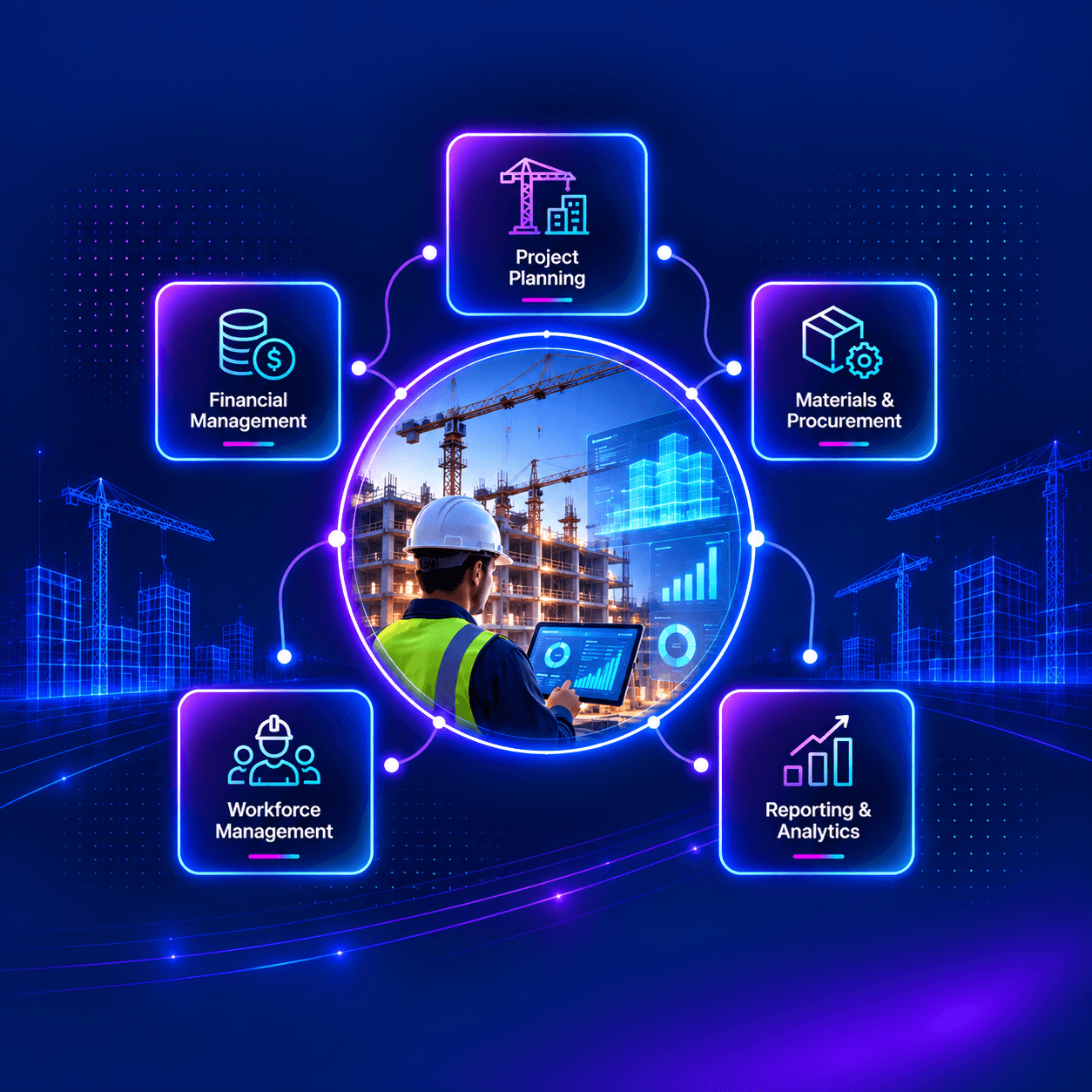
Business Central connects project accounting, procurement, billing, and financial management into a single platform. When a cost is posted to a project, it updates the job cost ledger, adjusts WIP calculations, flows into the general ledger, and feeds reporting dashboards in real time with no manual reconciliation. Here is what the platform covers, organized by functional area:
Create projects with hierarchical task structures that map to your cost code system. Each project tracks budgeted vs. actual costs across labor, materials, subcontractors, equipment, and overhead. Project task lines support multiple phases, milestones, and cost categories within a single job.
Track employee hours against projects using built-in time sheets with manager approval workflows. Assign resources based on skill sets and availability. Resource capacity planning helps avoid overbooking and ensures the right people are allocated to the right projects.
Track equipment usage, maintenance schedules, and costs per project. Allocate equipment costs to specific jobs based on utilization hours. Fixed asset management handles depreciation, insurance tracking, and disposal for owned equipment.
Maintain contracts, change orders, insurance certificates, lien waivers, inspection records, and submittals within the ERP. Role-based access controls ensure sensitive documents are visible only to authorized users.
Route purchase orders, change orders, expense reports, and billing drafts through multi-level approval workflows based on value thresholds, project authority, and organizational hierarchy. Approvals can be managed from desktop, mobile, or directly within Microsoft Teams.
Built-in Power BI integration provides real-time dashboards for job profitability, cost variance by trade, WIP positions, cash flow projections, subcontractor performance, and portfolio-level visibility. Custom dashboards can be built for any metric your leadership team tracks.
Build custom mobile apps for site managers and field teams using Power Apps: daily logs, quality inspections, equipment usage tracking, safety incident reporting, and photo documentation. Data flows directly into Business Central without manual re-entry.
Track prospective projects from lead through bid submission to contract award. Manage customer relationships, bid history, and win/loss analysis. For firms with more advanced CRM needs, Business Central integrates with Dynamics 365 Sales for full customer engagement management.
Construction firms operating across subsidiaries, joint ventures, or international projects can manage multi-entity accounting, intercompany transactions, and multi-currency procurement within a single Business Central environment. Consolidated financial reporting rolls up across all entities.
Job costing is the financial backbone of every construction firm. Business Central's project accounting framework tracks every dollar against the job it belongs to, giving project managers and controllers real-time visibility into where money is going, where it is coming from, and whether a project is on track.
Business Central's project task lines function as your cost code system. You define the hierarchy: phases, divisions, cost types, or whatever structure your firm uses. Every transaction posts to a specific task line, creating a detailed cost breakdown that maps to your estimating structure.
Every project carries a budget from your estimate and tracks actual costs as they post. Variance reporting shows the difference at every level: overall project, phase, task, and cost code. Project managers see budget consumption in real time rather than waiting for monthly reports.
Purchase orders and subcontractor commitments that have not yet been invoiced are tracked as committed costs. This gives controllers a complete picture of total project exposure: actual costs posted plus commitments outstanding, compared against the original budget plus approved change orders.
Business Central supports cost-to-complete estimates that feed WIP and revenue recognition calculations. Project managers can update their forecast at any time, and the financial impact flows through to WIP reporting and financial statements automatically.
Support for Standard, FIFO, Average, and Specific costing methods for inventory items. Equipment and labor costs can be configured with specific rate tables per project or resource, ensuring cost accuracy across different project types.
Subcontractors typically represent 60% to 80% of total project costs on commercial construction projects. Managing subcontractor contracts, payments, compliance, and change orders effectively is not just an operational concern. It directly determines project profitability.
Create and manage subcontractor agreements as purchase orders tied to specific projects and task lines. Track contract amounts, approved change orders, invoiced amounts, and retention balances per subcontractor per job.
Track change orders from request through approval to financial posting. Each change order adjusts the project budget, updates committed costs, and creates an audit trail. Approval workflows route change orders based on value thresholds and project authority levels.
Track insurance certificates, lien waivers, safety certifications, and bonding documentation per subcontractor. Configure alerts for expiring documents so payments are not released to non-compliant vendors. For details on compliance requirements, see the Compliance section below.
Process subcontractor payment applications against contract values, approved change orders, and completed work. Retention tracking holds back the contractually agreed percentage and manages its release against project milestones or substantial completion.
Construction billing is fundamentally different from standard invoicing. Progress billing, retainage, milestone payments, and cost-plus billing require an ERP that understands construction's unique revenue recognition patterns.
Bill customers based on percentage of completion, milestones achieved, or cost-plus calculations. Business Central supports configurable billing formats including AIA-style applications for payment (G702/G703). Billing schedules can be set per project with automated generation of draft invoices.
Track retainage held by customers on your billings and retainage you hold on subcontractor payments. Business Central manages retention percentages, calculates retention amounts on each billing cycle, and tracks retention receivable and payable balances separately.
Business Central calculates Work in Process using multiple WIP methods: Cost Value, Sales Value, Percentage of Completion, Completed Contract, and Cost of Sales. WIP postings flow directly to the general ledger, ensuring financial statements reflect the true position of active projects.
Real-time comparison of billings against earned revenue highlights overbilled and underbilled positions per project. This visibility is critical for construction CFOs managing cash flow, financial reporting, and lender covenants.
Construction procurement operates differently from standard purchasing. Materials are bought for specific jobs, delivery timing is critical to avoid site delays, and vendor relationships span both one-time suppliers and long-term subcontractor partners.
Every purchase order can be linked to a specific project and task line. When goods are received and invoiced, costs post directly to the job cost ledger, eliminating manual cost allocation.
Maintain vendor records with pricing agreements, lead times, quality history, and compliance documentation. Configure approved vendor lists per material category. Compare vendor pricing across suppliers before committing.
Manage materials needed by required date per project. Business Central generates purchase suggestions based on project demand, current inventory, and vendor lead times.
Route materials directly from vendor to job site without warehousing. Drop shipment workflows create the purchase order and link it to the project record, tracking cost and delivery without physical inventory movement.
Construction financial management requires project-level cost tracking, WIP-adjusted financial statements, cash flow forecasting that accounts for retainage and billing cycles, and the ability to manage multiple entities and joint ventures.
Fully configurable general ledger with dimensions representing projects, cost centers, divisions, or any other reporting axis. All project transactions post to both the project ledger and the general ledger simultaneously.
Manage vendor payments with configurable payment terms, early payment discounts, and approval workflows. Process customer invoices from progress billing or milestone schedules. Aging reports show outstanding balances with project-level detail.
Business Central projects future inflows and outflows based on open receivables, payables, pending billings, and committed purchase orders. Copilot-assisted cash flow analysis helps construction CFOs anticipate the impact of billing cycles, retainage releases, and seasonal spending.
Automated bank reconciliation matches transactions to ledger entries. Copilot assists with matching suggestions for high-volume construction payment transactions.
Depreciation schedules, asset disposals, and insurance tracking for owned equipment and vehicles. Asset costs can be allocated to projects based on utilization.
Intercompany posting, elimination entries, and consolidated financial reporting across subsidiaries and joint ventures.
Construction firms operate under layered regulatory requirements covering tax, financial reporting, workplace safety, environmental standards, labor laws, and contractual obligations. Business Central provides a compliance framework that spans financial and operational compliance, with regional specifics handled through localization features and ISV extensions.
Business Central handles sales tax, VAT, GST, and use tax calculations across jurisdictions, with dedicated localization support per region.
Flexible chart of accounts, segment reporting, and financial statement schedules. Multi-entity consolidation with intercompany elimination and currency translation.
Every financial transaction is recorded with user, timestamp, and source document references. Role-based access controls, approval workflows, and segregation of duties support compliance and audit readiness.
Quality management and incident tracking capabilities provide a structured foundation for safety records, inspection documentation, and corrective action tracking. Firms extend this with dedicated EHS solutions from AppSource for comprehensive reporting, toolbox talks, and near-miss tracking.
Configure workflows for high-risk activity permits (hot work, confined space, excavation). Alletec's EPC365 includes built-in permit-to-work tracking and HSE audit planning for construction and EPC firms.
Document control, audit trail, and corrective action workflows support ISO 45001 compliance frameworks. Dedicated ISV extensions provide additional certification management and safety management system documentation.
Built-in carbon footprint tracking capabilities let construction firms monitor and report environmental impact data per project and across the portfolio, supporting growing regulatory and client sustainability requirements.
Track waste disposal, hazardous materials handling, and environmental incident reporting through configurable workflows. ISV extensions on AppSource provide deeper environmental compliance management.
For government-funded projects requiring prevailing wage compliance, Business Central integrates with certified payroll ISV solutions that generate WH-347 reports and track wage rates per trade per project.
Track employee classifications, overtime calculations, and labor cost allocations per project. Configurable time sheet approval workflows ensure labor costs are validated before posting.
Quality checks, test result tracking, and non-conformance management support ISO 9001 quality management frameworks. Document control and corrective action workflows maintain audit-ready quality records.
Environmental impact tracking, emissions monitoring, and corrective action workflows support certification requirements for construction firms committed to environmental management systems.
Track preliminary notices, lien waiver deadlines, and conditional/unconditional waiver documentation per project and subcontractor. Configure alerts for approaching deadlines to protect lien rights.
Track performance bonds, payment bonds, and bid bonds per project. Monitor bond capacity utilization and expiration dates. Maintain surety company documentation and correspondence within the ERP.
Track contractor licensing expirations, insurance certificate renewals, and bonding documentation per subcontractor and vendor. Configure alerts to prevent payments to non-compliant parties.
Business Central embeds AI directly into construction workflows through two layers. Copilot works alongside your project managers, estimators, and finance teams, surfacing insights and accelerating daily tasks inside the screens they already use. Autonomous agents work independently, processing transactions, matching documents, and executing workflows without manual intervention. Together, they reduce the back-office burden and give construction teams more time on the work that actually moves projects forward.
Copilot analyzes open receivables, pending billings, committed purchase orders, and retainage schedules to project future cash positions. For construction CFOs managing multiple active projects with staggered billing cycles, this provides the liquidity visibility that spreadsheet forecasts cannot match.
Ask Copilot questions about your project data in plain English: "which jobs are over budget this month," "show me subcontractor invoices pending approval," or "what is the WIP position on the highway project." Answers come instantly without building reports.
Copilot matches bank transactions to ledger entries automatically, reducing the manual effort of reconciling high-volume vendor payments and customer receipts.
Copilot generates AI-powered summaries and KPIs for inventory items, giving procurement managers instant visibility into stock health, reorder urgency, and supply risks for project-linked materials.
Reads incoming vendor and subcontractor invoices from email, matches them against open purchase orders, and creates draft purchase invoices for AP review. Construction firms processing dozens of material and subcontractor invoices daily can handle them with minimal manual intervention.
Monitors incoming order emails, extracts details, matches items, validates pricing, and creates draft orders. Useful for construction firms that also supply materials or products alongside project services.
Handles employee expense capture, receipt scanning, categorization, and posting through approval workflows. Construction teams managing travel, site visits, per diem, and equipment rental expenses can process them without paper forms.
Business Central's Model Context Protocol (MCP) server lets construction firms connect external AI tools directly to their ERP data. Build custom agents tailored to your operations: a project cost anomaly detector that flags unusual spending patterns, a compliance document checker that monitors subcontractor insurance expirations, or a job profitability scorer that ranks active projects by margin health.
EPC365 is a prebuilt, end-to-end project lifecycle management solution by Alletec, designed specifically for engineering, procurement, and construction companies. It brings together operations, finance, and project management on a unified Microsoft platform (Dynamics 365, Power Platform, and Azure) to give EPC firms real-time visibility, cost control, and the ability to deliver projects on time and within budget.
AI-powered copilots streamline bid creation, approvals, and submission. Comprehensive tender milestone tracking with configurable escalation workflows. Personalized dashboards provide pipeline visibility and bid success rates.
Create project Bills of Quantity and define all work packages with detailed scope, cost estimates, and resource requirements. Track execution against BOQ at a granular level throughout the project lifecycle.
Integrated procurement with budgetary controls, RFQs, AI agent-led quote comparison, and purchase order management. Alletec's P2P 365 vendor portal enables vendor onboarding, RFQ response, GRN processing, and invoice submission.
Track site activities, inventory, quality checks, risks, and issues in real time. Dynamic rescheduling capabilities address unforeseen delays. Milestone tracking and AI-driven predictions for potential delays or resource bottlenecks.
Safety inspection and test planning, audit execution, non-conformance tracking, incident reporting, permit-to-work tracking, and environmental emissions monitoring. Central risk register with probability/impact scoring, mitigation strategies, and escalation workflows.
Support for milestone-based, delivery-based, running account (RA), and T&M billing. WIP accounting, revenue recognition, advance and retention management, and project-wise P&L.
Fixed asset lifecycle management, equipment usage tracking, maintenance planning. For energy projects: PPA management, meter tagging, SCADA integration, and energy generation tracking.
Copilot-assisted summaries and variance explanations. AI-driven early identification of cost or schedule risks. Automated alerts for deviations. Portfolio-level insights for leadership.
“Alletec understood our business and created a solution aligned to our scale and growth. We were impressed by their vertical experience, D365 BC expertise, and ability to simplify complex ERP transitions.”
One of Business Central's strongest advantages over competing construction ERPs is its native integration with the Microsoft ecosystem. For construction firms already using Microsoft 365, Teams, or Power BI, Business Central connects without middleware or custom APIs.

Create purchase orders, send vendor communications, and process subcontractor correspondence directly from Outlook. The Sales Order Agent drafts orders from incoming emails automatically.

Share live project cost reports, WIP summaries, and budget variance alerts in Teams channels. Project managers can share a job status update without exporting to a spreadsheet.

Real-time dashboards for construction analytics: job profitability, cost variance by trade, WIP positions, cash flow projections, and subcontractor performance.

Automate construction workflows: route change order approvals based on value thresholds, send alerts when subcontractor insurance expires, trigger purchase orders when material requisitions are approved.

Build custom mobile apps for field data capture: daily logs, quality inspections, equipment usage, safety incidents. Use Copilot Studio to create AI agents connected to Business Central via the MCP server.

Connect to Azure IoT for equipment telematics and site monitoring, Azure AI Services for predictive project analytics, and Azure Data Lake for portfolio-level analysis.

Integrate scheduling from Microsoft Project with Business Central's financial tracking. Project schedules feed resource planning while actual costs feed schedule updates.
Business Central is sold in two main user license tiers: Essentials and Premium, plus a low-cost Team Members tier. Most construction firms can operate on Essentials since project management and job costing are included in that tier. Premium is needed only if you also require production orders (for firms with manufacturing operations) or service management.
| Capability | Essentials$80/user/month | Premium$110/user/month |
|---|---|---|
| Financial Management | ✓ | ✓ |
| Project Management & Job Costing | ✓ | ✓ |
| Purchasing & Procurement | ✓ | ✓ |
| Sales & Invoicing | ✓ | ✓ |
| Inventory & Warehouse | ✓ | ✓ |
| Time Sheets & Resources | ✓ | ✓ |
| Production Orders | ✗ | ✓ |
| Service Management | ✗ | ✓ |
| Copilot & AI Features | ✓ | ✓ |
| Power BI Integration | ✓ | ✓ |
A low-cost Team Members license ($8/user/month) is available for light users who only need read access and limited data entry, and can be mixed with either tier. For current per-user pricing, check the Microsoft Dynamics 365 pricing page as rates vary by region and agreement type.
Licensing is only part of the total investment. Construction firms should budget for these additional cost layers:
Implementation covers the full scope of getting Business Central configured for your construction operations: requirements scoping, chart of accounts and cost code setup, project accounting configuration, data migration from your existing system, custom workflow development, and third-party integrations. Scope and cost vary significantly based on number of entities, project complexity, and integration requirements.
Successful adoption requires structured training for project managers, controllers, AP/AR staff, and field teams. Alletec includes change management in every engagement because the fastest implementation fails if your project managers keep running their jobs in spreadsheets instead of the ERP.
After go-live, your Business Central environment needs ongoing support: performance monitoring, troubleshooting, and help evaluating and adopting new features from Microsoft's twice-yearly release updates. Construction firms also benefit from periodic health checks to optimize project accounting configurations as operations evolve.
Most construction firms extend Business Central with purpose-built ISV solutions from Microsoft AppSource for retainage tracking, AIA billing, certified payroll, document management, or advanced approval workflows. These are separate costs that should be scoped during implementation planning.
The real value of a manufacturing ERP shows up in the numbers that matter to your business — faster close cycles, fewer stockouts, lower production costs, and better margins. Business Central delivers these results because it eliminates the disconnects between production, inventory, and finance that cause most operational waste. Here is where manufacturers see the most measurable impact:
When production costs post to the general ledger in real time, month-end reconciliation goes from a multi-day exercise to a review process. Finance teams spend less time chasing numbers and more time analyzing them.
Standard costing with real-time variance analysis means you always know your actual production costs — not an estimate that gets trued up after the fact. This directly improves pricing accuracy and protects margins on every product line.
Consolidating production, inventory, finance, and reporting into one platform eliminates the licensing, integration, and maintenance costs of running multiple disconnected systems.
Automated MRP replaces manual spreadsheet planning. Instead of planners spending hours calculating material needs and cross-referencing purchase orders, the planning worksheet generates a prioritized action list in minutes.
Real-time inventory with automated replenishment keeps materials available when production needs them without overstocking. Manufacturers typically see significant reductions in both emergency purchases and carrying costs.
Autonomous agents handle sales order processing, invoice matching, and expense management. Flushing methods automate shop floor material consumption posting. Every automated transaction is a manual task removed from someone's day.
Business Central's embedded Copilot and agent framework means manufacturers are not just buying an ERP — they are building a platform that gets smarter over time. Predictive insights, natural language queries, and custom AI agents are available now, not on a future roadmap.
Business Central grows with your operation. Add users, locations, production lines, or expand into new markets without migrating to a different ERP. The same platform that runs a 20-person shop can run a 500-person multi-site operation.
Native integration with the Microsoft ecosystem — Teams, Power BI, Power Automate, Azure — means your ERP is not a standalone silo. It feeds real-time data into the tools your team already uses for collaboration, reporting, and automation.
As a cloud-native platform, Business Central updates automatically twice a year, runs on Microsoft Azure's enterprise-grade infrastructure, and eliminates the risks of managing on-premises servers, backups, and disaster recovery.
Lot traceability, serial number tracking, quality management, and role-based access controls give manufacturers the documentation trail regulators and auditors require — without building it manually.
Microsoft FastTrack methodology, combined with Alletec's 25+ years of manufacturing-specific experience and reusable industry templates, reduces the uncertainty that makes ERP implementations fail.
Choosing the right implementation partner is as important as choosing the right platform. A Dynamics 365 Commerce deployment touches POS hardware, e-commerce frontend development, payment gateway integration, order management configuration, and ERP data flows. Alletec brings the Microsoft credentials, retail domain expertise, and implementation methodology to deliver Commerce projects end-to-end.

Alletec has earned Microsoft Solution Partner Designation in all 6 solution areas validating full stack expertise across Business Applications, Data & AI, Azure Infrastructure, Digital & App Innovation, Modern Work, and Security.

Alletec is recognized among the top 1% of Microsoft partners globally, with direct access to Microsoft engineering teams, early product roadmap visibility, and priority support escalation.

Alletec follows Microsoft's structured deployment methodology that accelerates go-live timelines, reduces implementation risk, and ensures solutions are built on proven architectural patterns.
Alletec's construction practice covers general contracting, EPC, infrastructure, and specialty trades with consultants who understand job costing, WIP, retention, progress billing, and subcontractor management from hands-on project experience.
Alletec has built EPC365, a prebuilt project lifecycle management solution for engineering, procurement, and construction companies. EPC365 covers bid management, BOQ tracking, HSE compliance, risk management, vendor collaboration, and site-to-office financial consolidation on the Microsoft platform.
Alletec includes AI readiness assessment, Copilot configuration, and data architecture for AI workloads in every engagement. Your Business Central environment goes live with AI capabilities active from day one.
Book a free consultation to see Business Central in action with your project workflows. Our construction and Business Central experts will walk you through a tailored demo, help map your unique business processes to the platform, and identify where AI agents and Copilot can automate the work that slows your teams down today.