Most manufacturers today have sophisticated equipment, experienced teams, and established ERP systems and are still making critical production decisions on information that's hours (or sometimes days) old.
The shop floor generates signals continuously, from machines, job orders, quality checks, and sensor feeds. But that data travels slowly, lives in disconnected systems, and surfaces as a report after a specific period resulting in delayed action. For most, that leads to downtime in production or a missed maintenance window.
That lag between what production generates and what operations can act on is where efficiency bleeds out. It's an industry-wide reality. And it is exactly what AI-powered shop floor intelligence is here to change.
The OEE Gap: Where Production Capacity Goes Missing
Overall Equipment Effectiveness (OEE) is the metric that tells you how productively your planned production time is actually being used. It combines three factors: availability, performance, and quality. A score of 100% means every planned production minute is running at full speed, producing only good parts. In practice, 85% is the accepted benchmark for world-class manufacturing, a standard established by Seiichi Nakajima as part of the Total Productive Maintenance framework.
According to data from Evocon, based on OEE tracking across 50+ countries, the average OEE score across manufacturing organisations sits closer to 55–60%. That gap — from 60% to 85% — represents 25 percentage points of production capacity that doesn't show up in output. On a high-throughput line, that's not a small number.
What's driving it? The losses are well-documented: unplanned breakdowns, minor stoppages that operators don't log, speed losses that fall just below the threshold anyone notices, and quality failures during startup after a stoppage. None of these are mysterious. What's missing is the real-time visibility to catch them early and the analytical depth to understand why they keep recurring.
What Manufacturers Actually Need on the Shop Floor
Before getting to technology, it's worth being precise about what the shop floor actually requires — because "more data" is not the answer.
Real-time production visibility - Supervisors and plant managers need to see what's happening on the floor right now — which lines are running, which are idle, where output is falling behind plan, and where quality is slipping. Shift-end reports and morning dashboards are too late.
Predictive maintenance signals - Unplanned downtime costs U.S. manufacturers an estimated $50 billion annually, according to Aberdeen Research, with the average large manufacturer losing around $260,000 per hour when a critical line goes down.The ability to detect early warning signals from equipment — rising vibration, temperature drift, cycle time anomalies — before failure occurs is one of the highest-value interventions available to a manufacturing operation.
Connected production data - Most plants have production data living in disconnected systems — the ERP in one place, the MES in another, quality records in spreadsheets, and machine data sitting in PLCs with no path to the surface. Closing the OEE gap requires connecting these sources so the analytics layer has a complete picture.
Explainable, actionable insight - Data without context doesn't help anyone on a production floor. A dashboard showing OEE at 58% tells a plant manager something is wrong. It doesn't tell them where to go next. What operators and production leads need is insight that points to a specific machine, a specific shift, a specific failure mode — and ideally, a recommended action.
How Microsoft Dynamics 365 Closes the Shop Floor Analytics Loop
For manufacturers already running Microsoft Dynamics 365 Supply Chain Management, the foundation for shop-floor analytics is already partly in place. The question is how much of it is actually activated.
Production Floor Execution and Real-Time Visibility
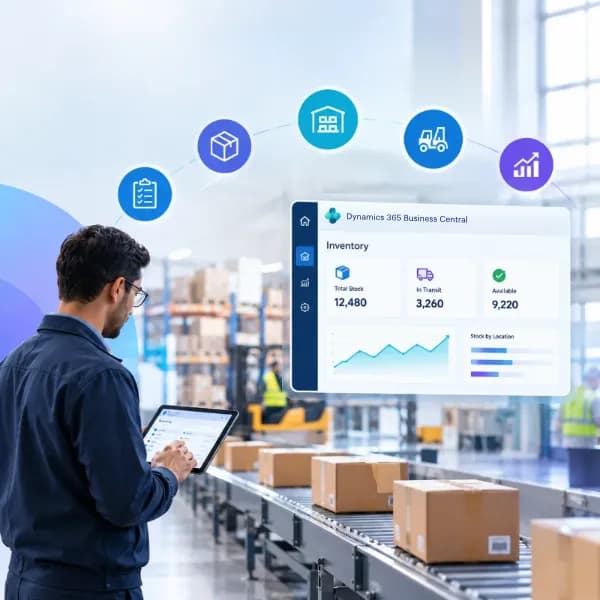
Dynamics 365 Supply Chain Management includes a Production Floor Execution interface designed to give workers and supervisors a live view of job orders, material availability, and production progress. Business Central similarly supports production order tracking, capacity planning, and shop-floor reporting within a unified ERP environment.
These native capabilities give manufacturers a structured way to capture production events — job starts, completions, material consumption, quality outcomes — directly inside the ERP, without relying on manual paper-based processes that introduce lag and inaccuracy.
IoT Integration: Connecting Machines to the ERP
The ERP records what people report. IoT connects what machines are actually doing.
Through Azure IoT Hub and Azure IoT Central, manufacturers can stream real-time sensor data — from PLCs, SCADA systems, and connected assets — directly into the Microsoft ecosystem. Dynamics 365 Supply Chain Management supports IoT sensor data intelligence natively, enabling equipment health monitoring, condition-based alerts, and predictive maintenance triggers that feed directly into asset management workflows.
This is where the shift from reactive to predictive maintenance becomes operationally real. When a motor's vibration signature begins to drift, or a conveyor's cycle time creeps above baseline, the system surfaces an alert before a failure occurs — not after.
Power BI: Making the Data Usable
Connecting data is one thing. Making it meaningful to a plant manager running three shifts is another.
Dynamics 365 SCM integrates natively with Microsoft Power BI, enabling embedded OEE dashboards, production performance reports, downtime analysis, and quality trend tracking without requiring a separate analytics platform. Manufacturers can monitor throughput by line, shift, and SKU; track downtime reasons and frequencies; and identify which assets are consistently underperforming and why.
Crucially, Power BI dashboards in this context aren't static reports. They reflect live production data, which means supervisors can act on what they're seeing in the moment — not the morning after.
Copilot: From Dashboard to Dialogue
The most recent layer in the Microsoft manufacturing stack is Copilot in Dynamics 365, which changes how production teams interact with their data.
Rather than navigating dashboards to find an answer, users can ask questions in natural language: why did Line 3 underperform during the night shift? Which work centres have had the most unplanned stoppages this month? What's driving the scrap rate increase on this production order?
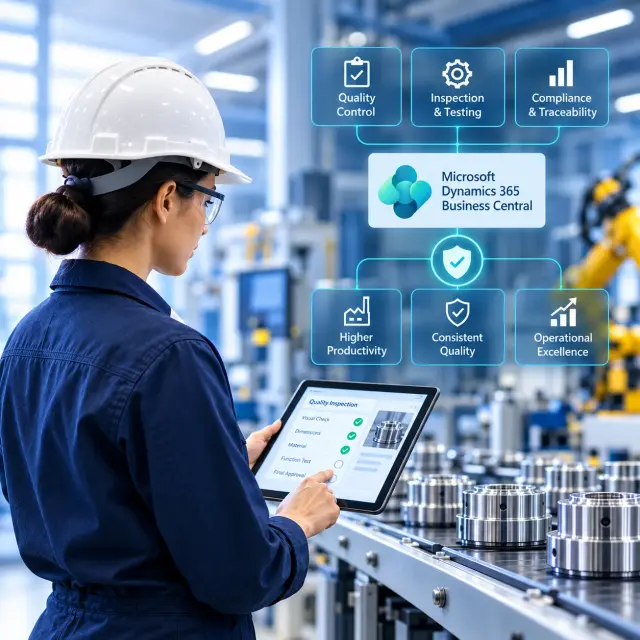
Copilot in Dynamics 365 Supply Chain Management also introduces Traceability Copilot, which tracks actual products through production and maintains a complete activity history — valuable for quality investigations, regulatory compliance, and root-cause analysis.
For demand planning, Copilot adds cell-level explainability — letting planners understand not just what the forecast is, but why it changed, and which signals drove the adjustment. This kind of transparency matters when production decisions downstream depend on planning accuracy.
The Integration Advantage
One of the structural advantages of building shop-floor analytics on the Microsoft stack is that the data doesn't need to travel far to become useful.
When production data lives in Dynamics, IoT signals flow through Azure, analytics run in Power BI, and AI assistance surfaces through Copilot, the entire loop — from shop-floor event to management decision — happens within a connected, governed environment. There are no CSV exports, no manual reconciliations, no gap between what the ERP knows and what the analytics tool sees.
For manufacturers also running Microsoft 365, this integration extends further. Production alerts can surface in Teams. Maintenance work orders can be actioned from a mobile device. Quality exceptions can trigger workflows without anyone leaving the Microsoft environment.
Where Shop-Floor AI Is Heading
The trajectory from here is clear, even if most manufacturers are still working toward the foundational steps.
Digital twins – Virtual replicas of production lines that mirror real-world machine states in real time — are moving from aerospace and automotive pilot programs into broader manufacturing adoption. Within the Microsoft ecosystem, Azure Digital Twins provides the infrastructure to model physical assets and simulate production scenarios before making changes on the floor.
Autonomous agents – AI Agents are the next frontier. Rather than surfacing an alert that a maintenance engineer then acts on, an AI agent in a mature manufacturing environment will initiate the work order, check parts availability, schedule the maintenance window against production capacity, and notify the relevant team — with a human reviewing and approving rather than initiating. Microsoft's direction with agentic capabilities in Dynamics 365, announced at Hannover Messe 2026, is explicitly oriented toward this model: AI that doesn't just advise, but acts within governed boundaries.
The manufacturers building clean, connected shop-floor data architectures today are the ones who will be positioned to deploy these capabilities when they arrive — and to do it without a multi-year data remediation project first.
A Practical Starting Point
For manufacturers on Dynamics 365 Finance & SCM or Dynamics 365 Business Central, the path to AI-powered shop-floor analytics doesn't require a greenfield implementation. It starts with understanding what data you already have, where it's connected, and where the gaps are.
- Is your Production Floor Execution interface capturing job and material data in real time, or are operators still logging on paper?
- Are your critical assets connected to IoT sensors, or is equipment health still assessed through scheduled inspections and operator judgment?
- Are your Power BI dashboards pulling live production data, or working from nightly data extracts?
The answers to those questions define where to focus first. The technology to go further is already inside the Microsoft stack — it's a matter of activating it in the right sequence.
Alletec brings deep manufacturing and Microsoft Dynamics expertise to help production-focused organisations turn shop-floor data into operational intelligence — whether that's connecting the floor to your ERP, activating AI and Copilot capabilities, or building the data foundation that makes predictive performance possible.
Already on Dynamics 365 or evaluating Microsoft Dynamics 365 for your manufacturing operations? Talk to our experts about where to go next.