

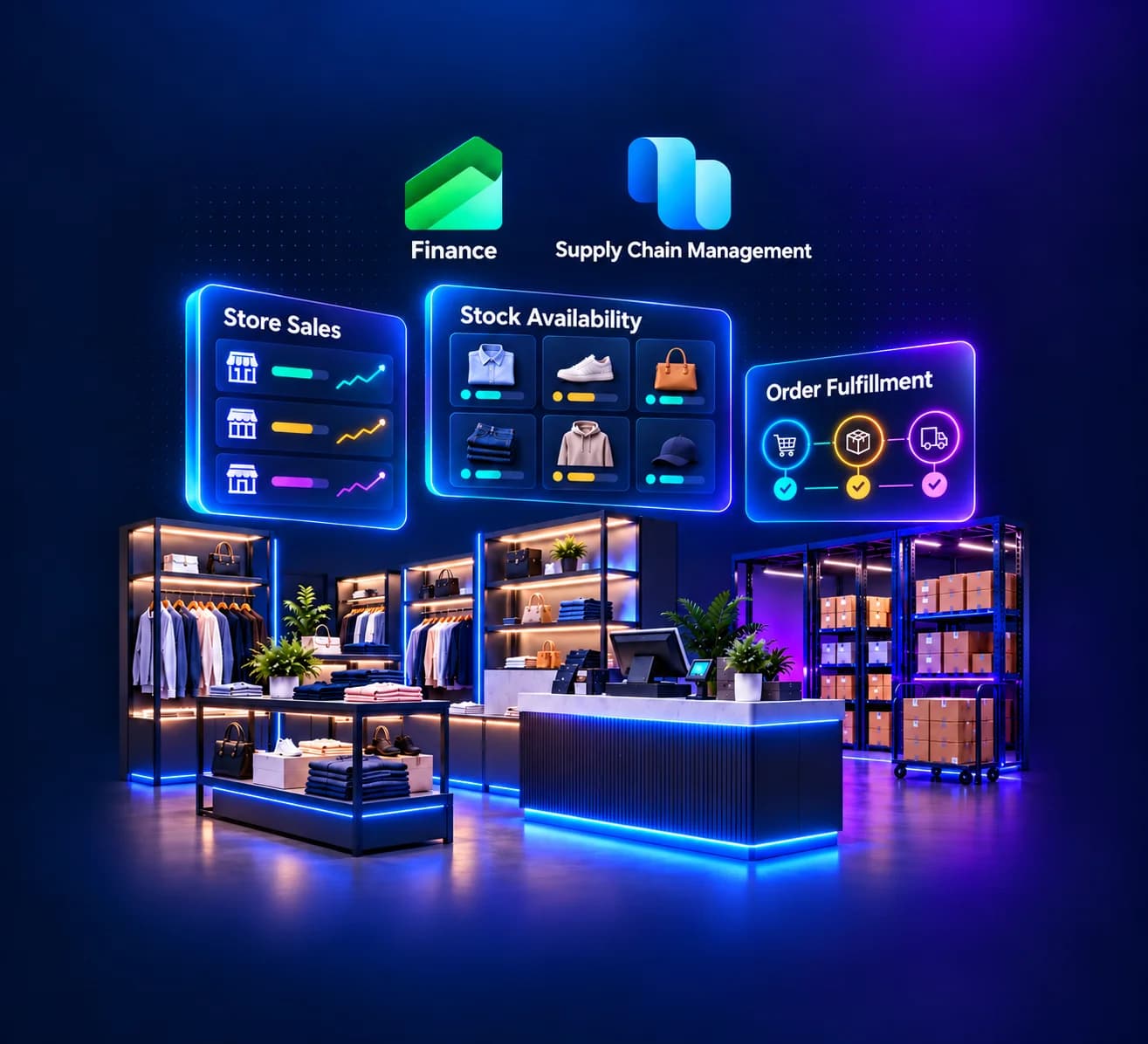
Retail growth rarely happens all at once. It comes in pieces — a new banner from an acquisition, a new country with its own tax rules, a new fulfillment model, a digital channel added on top of the point of sale. Each piece works fine by itself. Together, they add up to more legal entities, more currencies, and channels that don't share the same data. At some point, enterprise retailers hit a wall where the system — not the market — is what's holding growth back.
Dynamics 365 Finance and Supply Chain Management is Microsoft's enterprise resource planning (ERP) platform for organizations operating at a scale single-instance, mid-market systems weren't built for. For retailers, that means multiple banners, multiple legal entities, multiple currencies, and both physical and digital channels running as the everyday normal, not the exception. The platform unifies merchandising, inventory, procurement, and financial consolidation into one connected data model, and extends to the storefront and point of sale through Dynamics 365 Commerce, in place of the separate systems, spreadsheets, and manual reconciliation that most growing retailers eventually inherit.
Retail spans a wide range of verticals, each with its own merchandising, inventory, and fulfillment patterns. Here's how Dynamics 365 Finance and Supply Chain Management applies across the most common retail verticals:
Item variant management across size, color, and style, seasonal assortment planning, and multi-tier pricing support fashion and apparel retailers managing complex SKU matrices and fast seasonal turnover across stores and digital channels.
Shelf-life management, lot and expiry tracking, and high-velocity replenishment support grocery and food retailers managing perishable inventory and thin margins across large store networks.
Serial number tracking, rapid product lifecycle management, and vendor rebate tracking support electronics and consumer tech retailers handling fast-moving price points and frequent product refreshes.
Made-to-order and drop-ship fulfillment, extended delivery windows, and vendor-managed inventory support home and furniture retailers selling large-format items that rarely ship from shelf stock.
Lot tracking, regulatory documentation, and loyalty-driven promotions support health and beauty retailers managing compliance requirements alongside high-frequency repeat purchases.
High-transaction-volume POS, rapid replenishment, and multi-site inventory visibility support convenience retailers running large store counts with limited backroom space.
Multi-entity consolidation, centralized master data governance, and banner-specific pricing and promotions support department stores and multi-banner groups operating several distinct retail brands on one financial and operational backbone.
Enterprise retailers need more than a point of sale. Dynamics 365 Finance and Supply Chain Management covers the back-office value chain that sits behind every store and digital channel — from merchandising and inventory to procurement and financial consolidation.
Item variants for size, color, and style, product categories, attributes, barcodes, and cross-references or substitutions are managed centrally, so a product is defined once and used consistently across every store, warehouse, and digital channel.
Price lists, customer price groups, line and invoice discounts, and campaign-based pricing apply consistently across channels, replacing the manual price updates that create inconsistent pricing between stores and digital storefronts.
Supplier item records and pricing agreements are governed centrally, giving buyers one source of truth when negotiating terms and comparing vendors across product categories.
Assortments can be planned and adjusted by banner, channel, or region, supporting the seasonal buying cycles and localized product mixes that multi-banner retailers manage across their store networks.
General ledger, accounts payable and receivable, and multi-currency consolidation roll up automatically across legal entities, replacing manual, spreadsheet-based consolidation across banners and retail subsidiaries. Learn more about Dynamics 365 Finance.
Inventory availability, in-transit stock, and allocated quantities are visible across every store, warehouse, and legal entity in real time, giving merchandising and fulfillment teams accurate available-to-promise data regardless of which entity technically owns the stock.
Intercompany trade agreements automate the purchase and sales orders, transfer pricing, and financial postings that occur when one banner or entity sells to another within the same organization, eliminating manual journal entries at month-end close.
Item masters, customer and vendor records, and pricing structures are governed centrally and shared across entities, so a product, customer, or vendor is defined once and used consistently everywhere it appears in the business.
Purchase orders, vendor pricing agreements, and requisition workflows run through configurable approval processes, with automated requisition worksheets generating purchase suggestions based on demand, reorder points, and vendor lead times.
A dedicated vendor collaboration portal gives suppliers direct, secure access to purchase orders, delivery schedules, and invoice status, reducing the manual back-and-forth that slows down procurement cycles for retailers managing large supplier networks.
Landed cost functionality allocates freight, insurance, customs duties, and handling charges to inventory value, so margin calculations reflect true cost of goods for retailers sourcing product internationally.
Vendor and customer rebate agreements, trade promotions, and allowance tracking are managed and reconciled within the same platform that processes the underlying purchase and sales transactions, instead of in a separate spreadsheet-based rebate process.
Cost of goods, gross margin, and profitability are tracked by product, category, store, banner, or channel in real time, giving finance and merchandising teams a shared view of what's actually driving performance.
Cash flow forecasting accounts for seasonal buying cycles, payment terms, and promotional calendars, giving finance teams visibility into working capital needs ahead of peak selling seasons.
Power BI dashboards surface sales trends, inventory turnover, shrinkage, and basket analysis in real time, pulling directly from the same data model that runs the back office. For more on how this connects to in-store and digital performance, see the Dynamics 365 Commerce section below.
Financial reporting consolidates across currencies and countries natively, supporting retailers operating stores and digital channels in multiple markets without a separate consolidation tool.
Dynamics 365 Finance and Supply Chain Management covers the retail back office: merchandising, inventory, procurement, and financial consolidation. But running stores and digital channels also requires a POS that handles high-volume transactions, a digital storefront, and order fulfillment logic that spans both. Dynamics 365 Commerce is Microsoft's headless, omnichannel retail and B2B commerce platform, and it's natively integrated with Dynamics 365 Finance and Supply Chain Management — commerce operations share the same data layer as financial management, inventory planning, and supply chain execution, so there's no middleware, no custom integration, and no reconciliation lag between the storefront and the back office.
A cross-platform point of sale that runs on Windows, iOS, and Android across fixed terminals, mobile devices, and self-checkout kiosks, with offline operation so stores keep transacting through network outages and assisted-selling features that surface purchase history and next-best-action recommendations at the register.
Responsive, React-based storefronts serve consumer, business, and wholesale buyers from the same platform, with a drag-and-drop Site Builder CMS and B2B self-service ordering, customer-specific catalogs, and trade agreement pricing for wholesale buyers.
Intelligent, rules-based fulfillment routing sources orders from stores, warehouses, and distribution centers based on cost, proximity, inventory, and service-level requirements, powering buy-online-pickup-in-store, ship-from-store, and curbside pickup while minimizing shipment splits.
One pricing engine manages attribute-based pricing, price segmentation, and promotional offers across every channel, with a configure-simulate-approve workflow that lets merchandisers test pricing rules before they go live online, in store, or through the call center.
A 360-degree customer view brings together purchase history, preferences, and loyalty data across every channel, and call center agents work from the same catalog, inventory, and pricing data as online and in-store teams.
Dynamics 365 Finance and Supply Chain Management and Dynamics 365 Commerce embed AI through two layers for retailers: Copilot works alongside merchandising, store, and finance teams inside existing workflows, and configurable AI agents handle defined, repetitive tasks through automation with built-in approval workflows. Together they reduce manual work across merchandising, procurement, store operations, and multi-entity finance.
Merchandising and planning teams ask natural-language questions about demand plans and get back trends, anomalies, and accuracy assessments as summaries and visualizations, instead of building custom reports to answer the same questions.
Copilot drafts product descriptions, marketing copy, and SEO content from item attributes, useful for retailers onboarding new products or managing large, fast-changing catalogs across digital channels.
Store associates using Store Commerce POS receive AI-generated customer summaries, next-best-action suggestions, and calibrated upsell and cross-sell recommendations during checkout.
Azure AI Search powers contextual product discovery across online and in-store channels, using natural-language queries and personalized ranking instead of simple keyword matching.
Controllers and planners ask natural-language questions and get answers pulled from the structured finance and operations data they already have access to, without needing a pre-built report.
Monitors vendor and supplier communication — purchase order updates, delivery delay follow-ups, and change requests — through configurable automation with approval workflows, freeing buyers for higher-value supplier relationships across large retail supplier networks.
Flags differences between the subledger and general ledger, proposes resolutions, and can resolve certain discrepancies through configurable automation with approval workflows, keeping multi-banner retailers closer to continuous close.
Dynamics 365 Finance and Supply Chain Management ships with a generally available Model Context Protocol (MCP) server, and Dynamics 365 Commerce has its own MCP server in public preview, giving AI agents structured, secure access to a retailer's data and business logic across both platforms. Retailers can use Copilot Studio, Microsoft Foundry, or other agent platforms to build custom agents that span planning, selling, and settlement.
An agent that reads sell-through data and inventory age to recommend markdown or pricing adjustments for slow-moving items, built through the Commerce MCP Server.
An agent that cross-checks vendor rebate claims against purchase volumes and contract terms, flagging discrepancies before they reach accounts payable.
An agent that handles product discovery, cart building, and checkout through messaging apps, voice assistants, or GenAI interfaces, built on the Commerce MCP Server's customer-intent tools.
Operating stores and digital channels across multiple countries and legal entities multiplies the compliance surface retail finance and operations teams have to manage: sales tax, payment security, product safety, and labor rules. Dynamics 365 Finance and Supply Chain Management and Dynamics 365 Commerce address this at the platform level, organized into five compliance areas.
The Global Tax Calculation Service and Globalization Studio provide a configurable, country-specific tax engine per legal entity, covering requirements such as US sales tax and 1099 reporting, Canada GST/HST, India GST with TDS and TCS, and UAE VAT — alongside GAAP- and IFRS-aligned financial reporting and audit trails for retailers consolidating across these regions.
The right fit between these two Microsoft retail platforms comes down to scale. Here's where Business Central with LS Central gives way to Dynamics 365 Finance and Supply Chain Management with Dynamics 365 Commerce:
| Capability | Business Central + LS Central | F&SCM + Dynamics 365 Commerce |
|---|---|---|
| Multi-entity consolidation | Intercompany transactions; manual work for complex structures | Native multi-entity, multi-currency consolidation across global legal entities |
| Order fulfillment and routing | Store-level fulfillment through LS Central; no dedicated order-routing engine | Distributed Order Management with intelligent, rules-based fulfillment routing across stores, warehouses, and distribution centers |
| POS and omnichannel commerce | LS Central: POS, loyalty, replenishment, and eCommerce built within Business Central | Dynamics 365 Commerce: headless POS, D2C/B2B/wholesale storefronts, and call center, natively on F&SCM's data layer |
| B2B and wholesale selling | Limited; primarily consumer-facing retail workflows | Native B2B self-service storefronts, contract pricing, and multi-outlet ordering |
| Typical fit | Single to a handful of banners, regional chains | Multi-banner, multi-country, enterprise-scale retail and wholesale operations |
Licensing is the baseline. The real cost of a Dynamics 365 Finance and Supply Chain Management and Commerce implementation for a retail business depends on store and banner count, entity structure, channel mix, and implementation complexity.
| Feature | Dynamics 365 Finance | Dynamics 365 Finance Premium |
|---|---|---|
| Core financials | ✓ | ✓ |
| Business performance analytics (reporting and insights) | ✓ | ✓ |
| AI and machine learning capabilities | ✓ | ✓ |
| Account Reconciliation Agent (preview) | ✓ | ✓ |
| Business performance planning | Limited contributor access | Full admin/creator access |
| Capacity and storage entitlements | Standard | Higher entitlements |
| Copilot Credits for running agents | ✗ | 1,000/user/month included |
| Price (per user/month, billed annually) | $210 | $300 |
| Feature | Dynamics 365 Supply Chain Mgmt | SCM Premium |
|---|---|---|
| Core supply chain management | ✓ | ✓ |
| AI and machine learning capabilities | ✓ | ✓ |
| Procurement Agent (preview) | ✓ | ✓ |
| Demand planning | Limited | Full |
| Capacity and storage entitlements | ✗ | ✓ |
| Copilot Credits for running agents | ✗ | 1,000/user/month included |
| Price (per user/month, billed annually) | $210 | $300 |
| Dynamics 365 Commerce Component | What It Covers | Price |
|---|---|---|
| Dynamics 365 Commerce (core) | Store Commerce POS, Distributed Order Management, unified pricing and promotions, customer engagement, call center, and AI/Copilot features | $210 per user/month, billed annually |
| eCommerce add-on | Digital storefront management for D2C, B2B, and wholesale commerce | $4,000 per tenant/month, billed annually |
| Headless add-on | API-driven custom commerce experiences for custom frontends and marketplaces | $4,200 per tenant/month, billed annually |
Beyond licensing, four cost layers determine total investment:
Scoping, configuration, store and POS setup, data migration, and channel integrations determine cost and typically scale with the number of banners, legal entities, and stores involved.
Adoption, not licensing, is what determines return on investment, so training for store, merchandising, and finance teams is budgeted as its own workstream rather than an afterthought.
Post-go-live support, health checks, and release wave updates keep the platform current as Microsoft ships new Commerce, Copilot, and compliance capabilities.
Third-party apps, payment gateway integrations, and industry-specific extensions layer onto the core platform for retailers with specialized channel or compliance requirements.
No two F&SCM and Commerce retail deployments cost the same — it comes down to how many banners, stores, channels, and integrations are involved. A custom quote gets you the real number for your operation, not a ballpark.
Dynamics 365 Finance and Supply Chain Management connects natively with the broader Microsoft ecosystem, giving retailers connected tools for collaboration, automation, and analytics rather than a standalone ERP island.

Vendor communications, purchase orders, and customer correspondence are processed directly from Outlook, with the Supplier Communications Agent drafting responses to routine vendor emails for review.

Power BI dashboards surface sales trends, inventory turnover, and margin by store, banner, and channel; Power Automate triggers reorder alerts and shipping notifications; Power Apps builds custom mobile apps for store receiving and cycle counting; Copilot Studio extends AI agents into retail-specific workflows.

Azure-hosted infrastructure provides enterprise-grade security, automatic updates, and built-in disaster recovery, with Azure AI Search powering product discovery across online and in-store channels.

Fabric unifies retail data from Dynamics 365, trading-partner systems, and other sources into a single analytics layer, supporting cross-banner reporting and AI workloads without duplicating data pipelines.

Dynamics 365 Finance and Supply Chain Management connects with Dynamics 365 Sales for B2B quote-to-cash visibility and Dynamics 365 Customer Insights for unified customer segmentation and journey orchestration across physical and digital channels.
Alletec brings enterprise-grade Microsoft credentials and retail-specific delivery experience to every F&SCM and Commerce engagement.

Alletec has earned Microsoft Solution Partner Designation in all 6 solution areas, validating full stack expertise across Business Applications, Data & AI, Azure Infrastructure, Digital & App Innovation, Modern Work, and Security.
Alletec is a member of the Microsoft Inner Circle, representing the top 1% of Microsoft partners globally.

Alletec is a recognized Microsoft FastTrack partner, ensuring structured, accelerated deployments backed by Microsoft's own methodology.
Alletec brings more than 25 years of hands-on Microsoft retail and commerce implementation experience, from AX-era ERP through today's AI-first F&SCM and Commerce platform.
Alletec delivers enterprise-tier Microsoft implementations through delivery centers across the USA, Canada, Africa, the GCC, and India.
Alletec designs every F&SCM and Commerce retail implementation around Microsoft's Success by Design methodology with Hybrid-Agile layered in, building Copilot and AI agent adoption into the plan from day one.
Every acquisition, new market, fulfillment model, or digital channel you add changes what you need from your ERP — more legal entities to consolidate, more currencies to reconcile, more compliance requirements to meet, and more systems to keep in sync. Talk to Alletec's Dynamics 365 Finance and Supply Chain Management experts about what a rollout would actually look like for your banners, entities, channels, and compliance requirements — and where Dynamics 365 Commerce fits in.

