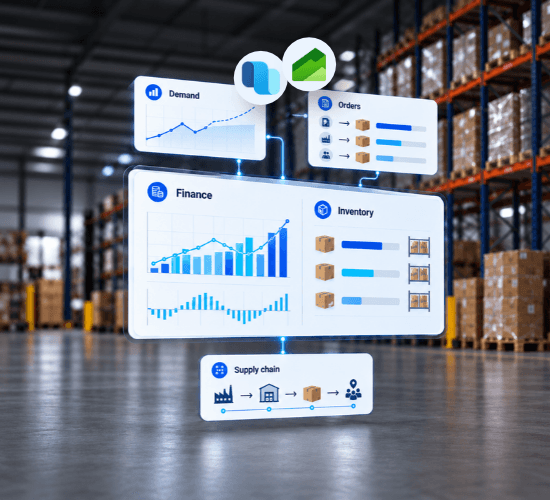
Global enterprises running finance and supply chain operations across dozens of entities, currencies, and jurisdictions can't stitch that visibility together from disconnected systems at scale.
Dynamics 365 Finance and Supply Chain Management (F&SCM), still widely known as Dynamics 365 Finance & Operations (D365 F&O), is Microsoft's enterprise resource planning platform for large, complex organizations — the successor to Dynamics AX, built for companies that have outgrown mid-market ERP. It brings financial management, supply chain, manufacturing, and operations into one connected data model, with AI and Copilot built into the platform.
That foundation is built for organizations with:
F&SCM natively consolidates financial and operational data across legal entities, currencies, and countries, giving finance leaders a single source of truth instead of reconciling spreadsheets from disconnected regional systems.
The platform supports discrete, process, and lean manufacturing alongside global distribution and warehouse operations, handling production and fulfillment complexity that outpaces smaller ERP systems.
Built-in localization and compliance capabilities support organizations operating under different tax regimes, statutory reporting requirements, and industry regulations simultaneously.





Dynamics 365 Finance and Supply Chain Management runs on two connected pillars: financial management and supply chain operations. Here's what each pillar covers.

General ledger, accounts payable and receivable, and multi-entity, multi-currency consolidation give finance teams a real-time, enterprise-wide view instead of month-end reconciliation across regional books.
Built-in planning tools let finance teams model budgets and forecasts directly against actuals, with AI-assisted variance analysis surfacing where plans are drifting from reality.
Bank reconciliation, cash flow forecasting, and treasury workflows give finance leaders visibility into liquidity across every entity and currency the organization operates in.

Sourcing, purchase orders, and vendor collaboration workflows are managed centrally, with AI agents now handling repetitive procurement tasks like purchase order updates and change requests.
Real-time inventory visibility, warehouse management, and AI-assisted demand planning help enterprises balance stock levels against actual and forecasted demand across locations.
Discrete, process, and lean manufacturing are supported natively, from production scheduling to shop floor execution and quality management.
Dynamics 365 Finance and Supply Chain Management embeds AI through two layers: Copilot works alongside your team inside familiar workflows, and configurable AI agents handle defined, repetitive tasks through automation with built-in approval workflows. Together, they reduce manual work in finance and supply chain operations while keeping the controls enterprises need.
Generates AI-written summaries and reminder letters in the Collections coordinator workspace, cutting the manual work of chasing overdue receivables across large customer books.
Surfaces an AI-generated summary at the top of every customer record, powered by Azure OpenAI Service, so finance teams get context without digging through transaction history.
Generates an AI summary on the Workflow history page across all workflow document types, giving approvers context on a transaction's approval path without opening each step individually.
Lets supply chain planners ask natural-language questions about demand plans and get back trends, anomalies, and accuracy assessments as summaries and visualizations, rather than building custom reports.
Gives warehouse teams Copilot-generated insights on pending work, pick lines, and workforce availability directly in the Warehouse Management mobile app.
A 2026 release wave capability that uses AI to recommend inventory rebalancing across warehouse locations, part of Microsoft's broader investment in AI-assisted warehouse operations.
A conversational assistant built into Finance and Supply Chain Management that answers “how do I…” questions directly inside the app, cutting down on support tickets for routine navigation questions.
Lets users ask natural-language questions and get answers pulled from the structured finance and operations data they already have access to, without needing a pre-built report.
Flags differences between the subledger and general ledger, proposes resolutions, and can resolve certain discrepancies through configurable automation with approval workflows, keeping large, multi-entity organizations closer to continuous close.
Handles repetitive procurement communication — vendor collaboration, purchase order updates, and change request management — through configurable automation with approval workflows, freeing procurement staff for higher-value supplier relationships.
Dynamics 365 Finance and Supply Chain Management ships with a generally available Model Context Protocol (MCP) server that gives AI agents structured, secure access to your F&SCM data and business logic — the same access an employee would have, with the same permissions. Enterprises can use it to build custom agents in Copilot Studio, Microsoft Foundry, or other agent platforms.
An agent that approves routine purchase requisitions under a defined dollar threshold and routes exceptions to a human approver.
An agent that applies a company's proprietary pricing or discount rules during quote generation, built through the MCP server's custom API integration.
An agent that reviews transactions against a specific jurisdiction's statutory reporting rules and flags entries that don't meet them.
Operating across multiple countries multiplies the compliance surface finance and operations teams have to manage — different tax regimes, different statutory reporting formats, different labor rules. Dynamics 365 Finance and Supply Chain Management addresses this at the platform level, organizing compliance capabilities into four areas:
Built-in support for multi-jurisdiction tax calculation, GAAP and IFRS reporting, and audit trail requirements gives finance teams a consistent compliance foundation regardless of how many countries they operate in, with region-specific tax engines configured per entity.
Dynamics 365 Finance and Supply Chain Management supports the operational complexity of large enterprises across a range of industries. Below is how it applies across six industries:

Process and discrete manufacturers use F&SCM to manage production scheduling, shop floor execution, and multi-plant cost visibility that outgrows mid-market ERP.

Enterprise retailers use F&SCM to unify omnichannel inventory, financial consolidation across regions, and demand planning at a scale single-store or mid-market retail platforms can't support.

Services organizations use Dynamics 365 Finance for project-based financials, resource and revenue recognition, and multi-entity billing across large client engagements.

Banks, NBFIs, and financial institutions use Dynamics 365 Finance for multi-entity, multi-currency financial consolidation, regulatory and statutory reporting, and treasury management across global operations.

Distributors use F&SCM for multi-warehouse inventory visibility, landed cost management, and global trade compliance across complex supply networks.

Construction and engineering firms use F&SCM for project cost control, subcontractor management, and multi-entity financial consolidation across large capital projects.
Dynamics 365 Finance and Supply Chain Management connects seamlessly with other Microsoft solutions, so the integrations below work together as one connected ecosystem rather than separate projects to manage.

Excel-based data entry and reporting, Outlook-embedded approvals, and Teams-based collaboration on financial and operational workflows are built into daily use, not layered on as a separate integration.

Power BI delivers real-time financial and operational dashboards directly against live F&SCM data, Power Automate handles workflow automation across approvals and notifications, and Copilot Studio extends the platform with custom agents built on the MCP server.

Azure OpenAI Service powers the Copilot summaries and insights throughout F&SCM, while Azure Data Lake supports large-scale data export for enterprise reporting and analytics needs beyond the platform itself.

F&SCM data can flow into Microsoft Fabric for unified analytics alongside data from other business systems, giving enterprises a single analytical layer across finance, operations, and beyond.

F&SCM connects natively with Dynamics 365 Sales and Dynamics 365 Project Operations, so orders and project data flow through to invoicing and financial reporting without manual re-entry.
Dynamics 365 Finance and Dynamics 365 Supply Chain Management are licensed separately, each on a Standard and Premium tier, though most enterprise deployments license both together. Here's what each tier includes.
| Feature | Dynamics 365 Finance | Dynamics 365 Finance Premium |
|---|---|---|
| Core financials | ✓ | ✓ |
| Business performance analytics (reporting and insights) | ✓ | ✓ |
| AI and machine learning capabilities | ✓ | ✓ |
| Account Reconciliation Agent (preview) | ✓ | ✓ |
| Business performance planning | Limited contributor access | Full admin/creator access |
| Capacity and storage entitlements | Standard | Higher entitlements |
| Copilot Credits for running agents | ✗ | 1,000/user/month included |
| Price (per user/month, billed annually) | $210 | $300 |
| Feature | Dynamics 365 Supply Chain Mgmt | SCM Premium |
|---|---|---|
| Core supply chain management | ✓ | ✓ |
| AI and machine learning capabilities | ✓ | ✓ |
| Procurement Agent (preview) | ✓ | ✓ |
| Demand planning | Limited | Full |
| Capacity and storage entitlements | ✗ | ✓ |
| Copilot Credits for running agents | ✗ | 1,000/user/month included |
| Price (per user/month, billed annually) | $210 | $300 |
Licensing is only part of the total investment. Budget for these additional cost layers as well:
Scoping, configuration, data migration, and custom workflow development make up the bulk of a F&SCM implementation's cost, and it varies significantly with the number of entities, modules, and customizations involved.
Adoption determines whether the platform actually changes how finance and operations teams work day to day, so training and change management budget should be planned alongside the technical rollout, not after it.
Post-go-live support, periodic health checks, and staying current with Microsoft's release waves keep the platform running as intended and prevent configuration drift over time.
Industry-specific extensions, custom API integrations built on the MCP server, and third-party app connections add to the total cost depending on how much customization your operations require.
No two F&SCM deployments cost the same — it comes down to how many users, modules, entities, and integrations you're running. A custom quote gets you the real number for your operation, not a ballpark.
Alletec brings enterprise-grade Microsoft credentials and F&SCM-specific delivery experience to every engagement.

Alletec has earned Microsoft Solution Partner Designation in all 6 solution areas, validating full stack expertise across Business Applications, Data & AI, Azure Infrastructure, Digital & App Innovation, Modern Work, and Security.
Alletec is a member of the Microsoft Inner Circle, representing the top 1% of Microsoft partners globally.
Alletec is a recognized Microsoft FastTrack partner, ensuring structured, accelerated deployments backed by Microsoft's own methodology.
Alletec brings more than 25 years of hands-on Microsoft implementation experience to every F&SCM engagement, from AX-era ERP through today's AI-first platform.
Alletec delivers enterprise-tier Microsoft implementations through delivery centers across the USA, Canada, Africa, the GCC, and India.
Alletec designs every F&SCM implementation around Microsoft's Success by Design methodology with Hybrid-Agile layered in, building Copilot adoption into the plan from day one.
Modernizing enterprise finance and supply chain operations is a significant undertaking, and the right implementation partner shapes how smoothly it goes. Alletec brings 25+ years of Microsoft full-stack expertise, all six Microsoft Solution Partner Designations, and an AI-first implementation approach to every Dynamics 365 Finance and Supply Chain Management engagement. Book a free consultation with Alletec's Dynamics 365 F&SCM experts to talk through your specific operations.