Retail customers have moved faster than the systems built to serve them. They expect every touchpoint of a brand to feel like the same conversation. A research found that 76% of buyers expect consistent interactions across every part of a brand they touch.
Most retailers can't deliver that today. Store, online, warehouse, and finance systems use a different tech stack, each holding a slightly different version of the same data. The 2025 Unified Commerce Benchmark from Manhattan Associates and Incisiv puts hard numbers on how few have closed that gap: only 5% of specialty retailers earned the Leader status, demonstrating exceptional omnichannel commerce maturity and delivering highly personalized experiences both in-store and online.
Let’s find out how the others can get there with Microsoft Dynamics 365.
The real cost of disconnected retail systems
For the other 95%, the gap between how customers shop and how systems actually work carries a measurable price. With global inventory distortion, the combined cost of out-of-stocks and overstocks reached $1.73 trillion in 2025, about 6.5% of retail sales, per IHL Group.
Most of that cost traces back to a familiar data problem. For most retailers, the number a system shows and the number on the shelf are often different. That gap surfaces every day as:
- Poor customer experience - For instance, when a customer asks for a specific product SKU variant, the system tells the store manager an item is in stock, but it is neither available on display nor in backroom storage, and the customer walks out empty-handed.
- Expensive fulfillment - The system routes orders to the wrong node because store and DC inventory positions don’t match, which pushes shipping costs up on every order.
- Disconnected loyalty and pricing – Different promos and offers run online and in-store, and loyalty points earned in one channel are not visible when the customer shops on another channels, leading to frustration and abandonment.
- Unreliable reporting - Finance, merchandising, and operations - each pull data from their own data warehouse, so the numbers don’t reconcile when the books close each month.
The root cause behind every one of these is the same: no shared data layer across channels and functions.
What is unified commerce in retail?
Unified commerce is what closes that gap. It brings every channel and every back-office function onto one data layer. Store, web, app, contact center, warehouse, and finance all read from and write to the same records.
So, what does this mean?
- One product and price record – A price or SKU description change made in one place shows up across the store, the website, the app, and the marketplace right away.
- One inventory position – A store associate checking backroom stock and the website quoting a delivery date based on stock availability both work off the same live count.
- One customer profile – Whether the customer is in the store, on the website, or on the app, the account profile displays the same order history and loyalty points balance leading to a seamless checkout experience.
- One transaction record – Fulfillment and finance use the exact same order data finance, so operations and financial reporting stay lined up.
How do unified commerce leaders outperform the rest
The retailers who've made this shift already lead the industry in operating metrics that matter. The 2025 Unified Commerce Benchmark for Specialty Retail from Manhattan Associates and Incisiv points to four capabilities that separate Leaders from the rest:
- Real-time inventory transparency – Leaders show accurate store-level stock right on the product page, which gives customers confidence to buy online or choose local pickup and lifts inventory turnover 23% higher than the rest of the market.
- Intelligent cart experiences – Leaders are able to provide synced shopping carts across the app, website, and marketplace. 70% of them offer intelligent cart experiences that speed up checkout and lowers cart abandonment about 20% lower.
- Flexible, distributed fulfillment – Leaders route each order to the best fulfillment node and let customers modify orders and delivery preferences after checkout. Half of them offer this post-purchase flexibility, reducing fulfillment costs by 31% and boosting CSAT by 24%.
- A unified view of every customer – Leading retailers can surface browsing history, past purchases, wishlists, and loyalty status at POS, and service agents see the full order and interaction record when a customer calls the customer care. That end-to-end visibility drives customer lifetime value 1.5x the industry average and cuts support escalations by roughly half.
How to build unified commerce on Microsoft Dynamics 365
Microsoft's Dynamics 365 retail stack covers store operations, e-commerce, supply chain, finance, and customer service on one integrated platform. That lets retailers consolidate the separate POS, ERP, e-commerce, and warehouse systems most of them use today. The choice of solution depends on scale, supply chain complexity, channel mix, and geographic footprint. Both paths share the same underlying data model, so investments compound as retailers add capabilities like Copilot and AI agents later.
1. Mid-market retailers: Business Central with LS Retail
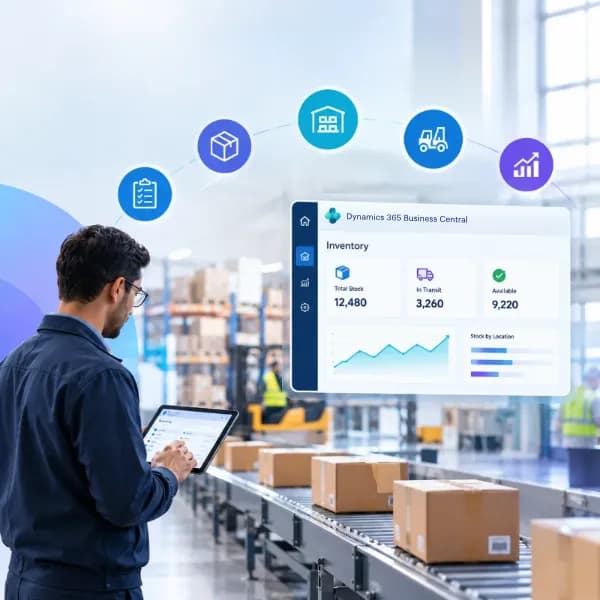
Dynamics 365 Business Central runs finance, inventory, purchasing, and warehousing on one platform. LS Central, built by LS Retail on top of Business Central, adds POS, store operations, replenishment, loyalty, and e-commerce integration. No separate POS-to-ERP integration is needed to build or maintain.
Best fit: store chains, franchise networks, specialty retailers, and grocery or convenience operations up to a few stores.
Value for retailers:
- One product, price, and stock record across every channel – When a merchandiser updates a price or product detail once, the store POS, website, app, and marketplace all pick it up immediately.
- POS that also works offline – Store associates can process sales even if the internet drops, and the transactions sync back to the ledger automatically once connectivity returns. That matters for chains with stores in areas where connectivity is spotty.
- Loyalty tied to the same customer profile on all channels – Loyalty points earned in any channel sit against the same customer record used by every team, so balances never fall out of sync across the app, POS, and call center.
- Reporting that reconciles from a single source of truth – Finance, merchandising, store operations, and supply chain all pull from the same ledger, so month-end numbers match without teams reconciling spreadsheets first.
2. Enterprise retailers: Dynamics 365 Finance, Supply Chain Management, and Commerce
Dynamics 365 Commerce runs as a headless, API-first engine for D2C, B2B, and call center channels, with Store Commerce POS in physical stores. Dynamics 365 Supply Chain Management adds warehouse management, distributed order management, demand forecasting, and inventory optimization capabilities. Dynamics 365 Finance runs the complete backend finance operations.
Best fit: multi-brand, multi-country retailers with high SKU counts and hundreds or thousands of stores.
Value for retailers:
- Distributed order management – The system routes every order to the node that can fulfill it fastest and cheapest, whether the closest store, a distribution center, a drop-ship partner, or a marketplace fulfillment network.
- Real-time inventory visibility across the network – The stock number a customer sees on the website matches what the store associate sees on the floor, so promises like BOPIS (Buy Online, Pick Up In-Store), ship-from-store, curbside, and same-day delivery actually hold up.
- One customer profile across the enterprise – Whether the customer starts on the web, comes into a store, calls the contact center, or shops in the app, every team pulls up the same record and history.
- Headless commerce for large-scale digital experiences – The commerce engine sits behind APIs, so retailers can build custom storefronts and scale across markets without rebuilding the core.
How to choose the right Dynamics 365 path for your retail business
To be able to pick the right stack for your retail business, it is imperative to understand your supply chain complexity or channel mix at the very start. A specialty brand with 40 stores in one market typically lands on Business Central with LS Central. A global brand running owned manufacturing, wholesale, and D2C channels will need Dynamics 365 Finance and Supply Chain Management with Dynamics 365 Commerce, even at a smaller store count.
Beyond the archetype, four other inputs shape the rollout:
- Priority pain points – The area where your biggest cost sits today shapes which capabilities need to come online first, whether that's inventory accuracy, fulfillment cost, cart abandonment, or service resolution.
- Data readiness – Master data accuracy and hygiene is critical for a unified platform to pay off. It almost always requires a cleanup, so one should budget for that work upfront.
- AI roadmap – The platform you pick shapes which Copilot and agents you can leverage later, so your future AI ambitions should influence the choice now.
- Compliance and geography – Tax regimes, data residency rules, localization requirements, and country-specific commerce features can push a mid-market retailer into the enterprise stack even at smaller scale.
Explore Microsoft Dynamics 365 for Retail & Commerce
How AI and Copilot are extending unified commerce operations
Microsoft has been extending Copilot into the areas of Dynamics 365 where retail teams do the highest-friction work. The capabilities retailers can leverage are:
- Copilot in Store Commerce POS - Customer Insights by Copilot puts the customer's profile, favorite categories, price range, and RFM signals right in front of the associate at the till, so associates can personalize service without leaving the checkout flow.
- Copilot for merchandising - The merchandising Copilot validates product and channel configurations, flags risks before they reach customers, and drafts product descriptions and metadata that would otherwise take a merchandiser hours to write.
- Copilot in Supply Chain Management - The 2025 release wave added cell-level explainability to demand planning, so planners can trace exactly why a forecast number shifted before they act on it.
- Supplier Communications Agent - Handles routine supplier back-and-forth (purchase orders, ASNs, invoices, and shipping updates), so procurement teams can focus on the supplier conversations that actually shape margin.
- Custom AI agents for retail workflows on Copilot Studio - Retailers can build their own custom agents in Copilot Studio to handle replenishment, allocation, ship-from-store fulfillment, and store operations. These agents run against the Dynamics 365 Commerce MCP Server, which lets them read and act on catalog, pricing, inventory, carts, orders, and fulfillment data across every channel a customer touches.
How JAZA Supermarkets unified 30 stores with Business Central & LS Retail
JAZA Discounter, a fast-growing Kenyan supermarket chain running ~30 stores and a central warehouse, is a real example of a retailer choosing the Business Central + LS Retail path to build unified retail and commerce operations.
Before the transformation, JAZA used a legacy RMS for POS. Their head office had no real-time view of the shop floor, month-end close was manual, and centralized pricing was out of reach.
Alletec deployed Business Central and LS Retail, in a record time of five months without downtime. The rollout unified finance, inventory, supply chain and operations across all stores into a single intelligent, real-time system. M-Pesa, KRA e-TIMS, Glovo, Brookside, and card gateway were also integrated before launch.
The new integrated retail ERP + POS streamlined and improved Jaza’s retail operations by providing real-time financial visibility and control, accurate stock visibility across ~30 stores, centralized pricing and promotions, automated vendor processes, integrated payments, improved forecasting accuracy, and enhanced customer experience. This positioned JAZA on the right path to achieve its goal of growing beyond 50 stores by end of 2026.
How Hotpoint is unifying enterprise retail on Dynamics 365 Finance, SCM and Commerce
Hotpoint Appliances is starting the same unification journey on the enterprise path. The East African retailer sells consumer electronics, home appliances, industrial laundry, and HVAC systems across 14 stores, and is expanding into new markets across East, Central, and Southern Africa.
Hotpoint's business runs deeper and is more complex. It operates across multiple entities and currencies, and its customer engagement footprint spans in-store, e-commerce, contact centre, field service, and after-sales. Right now, those functions are running on separate systems i.e. legacy ERP, a standalone CRM, a third-party HRMS, and disconnected POS and e-commerce infrastructure. Customer, product, inventory, and order data all sit in silos across those systems.
Alletec is now unifying that landscape on Dynamics 365 Finance, Supply Chain Management, and Commerce, with the wider Dynamics 365 family (Sales, Customer Service, Contact Center, Customer Insights, Field Service, and HR) extending the platform across every function. With this transformation, Hotpoint is moving toward one shared record for products, prices, inventory, and customers across every channel and entity, giving the business the same unified-commerce foundation JAZA now runs on, engineered for enterprise scale.
How Alletec helps retailers build unified commerce on Microsoft Dynamics 365
As an AI-first transformation partner, Alletec helps retailers move from fragmented store, e-commerce, warehouse, and back-office systems to a unified commerce operating model. The end state looks a lot like JAZA's: real-time inventory across stores, faster financial close, centralized pricing and promotions, a unified data platform, and AI & agentic use cases that scale with the business. We work with retailers already on Dynamics 365 who want to unify further, and with teams moving in from older POS, ERP, e-commerce, and warehouse combinations.
Planning a unified commerce move on Microsoft Dynamics 365? Talk to our experts to see what a practical rollout could look like for your business.