
Alletec Logo
Great Place to work Alletec
Join Us to Unlock the Intelligence Layer for Your Business atCommunity Summit North America
October 11-15, 2026|Nashville, TN
Booth #1919
Dynamics 365 Business Central for Trade and DistributionDynamics 365 Business Central for Trade and Distribution

Dynamics 365 Business Central
for Trade and Distribution

AI-Ready ERP for Smarter Supply Chain and Distribution Operations

The Pressure on Trade and Distribution: Tighter Margins, Faster Fulfillment, and Growing Complexity

Trade and distribution businesses operate at the intersection of supply and demand, moving products from manufacturers to markets across complex, multi-layered supply chains. The challenge compounds with scale: more SKUs, more warehouses, more suppliers, more customers, and more regulatory requirements across borders. Distributors and trading companies that still run on disconnected systems are finding that the gap between what their technology can handle and what the market demands is widening. Three forces are making connected ERP essential:

Inventory accuracy determines profitability

When stock data is spread across spreadsheets, standalone warehouse tools, and disconnected accounting systems, inventory counts are always wrong somewhere. Overstocking ties up working capital. Stockouts lose customers. Neither is visible until it shows up in the financials, weeks after the damage is done.

Fulfillment speed is now a competitive differentiator

Customers expect faster order cycles, real-time delivery tracking, and accurate availability promises. Distributors that cannot pick, pack, and ship within the expected window lose business to those that can. Manual order processing and disconnected logistics create bottlenecks that slow everything down.

Global trade adds layers of cost and compliance

Trading companies importing and exporting across borders must manage landed costs, customs duties, tariffs, multi-currency transactions, and trade documentation. When these are tracked manually, margins erode through miscalculated costs, compliance penalties, and delayed shipments.

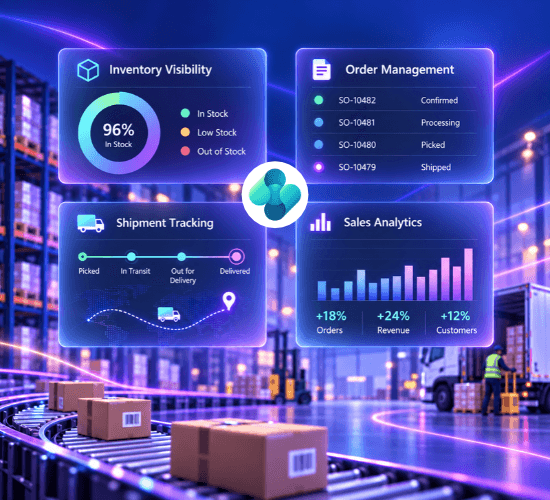
Dynamics 365 Business Central is a cloud-native, AI-ready ERP that connects inventory management, order processing, procurement, warehousing, logistics, and financial reporting into a single platform designed for the way trade and distribution companies actually operate.

Core Capabilities of Business Central for Trade and Distribution

At its core, a trade and distribution business runs on three things: products moving through the supply chain, orders flowing between buyers and sellers, and the financial picture tying it all together. Business Central connects all three so every purchase, every shipment, every sale, and every cost posts to the same live system. Here is what that covers:

Track stock levels across multiple warehouses, distribution centers, and transit locations in real time. Every receipt, transfer, sale, and adjustment updates inventory immediately. Automated replenishment generates purchase or transfer suggestions when stock drops below configured thresholds per item per location.
Manage the full sales cycle from quote through order, shipment, and invoicing. Configurable pricing rules, customer-specific discounts, volume breaks, and payment terms ensure every order is priced correctly. Blanket orders handle recurring customer agreements with scheduled deliveries.
Create and track purchase orders, manage vendor relationships, negotiate pricing agreements, and match invoices against receipts. Automated requisition worksheets generate purchase suggestions based on demand, reorder points, and vendor lead times.
Organize warehouse storage with bin codes, zones, and directed put-away and pick logic. Process warehouse receipts, shipments, and internal transfers with barcode scanning. Business Central supports both simple inventory locations and structured warehouse operations with wave picking and cross-docking.
Manage shipping agents, carrier services, and freight charges per shipment. Track shipments from dispatch to delivery. Assign freight costs to specific sales or purchase orders. Integrate with third-party shipping platforms for label generation and tracking updates.
Route orders directly from vendor to customer without warehousing. Drop shipment workflows create the purchase order linked to the sales order, tracking cost and delivery without physical inventory movement. Special orders reserve specific vendor shipments for specific customer orders.
Allocate freight, insurance, customs duties, handling fees, and other ancillary costs to inventory value using item charges. Landed cost calculations ensure true cost of goods is reflected in inventory valuation and margin analysis, not just the supplier invoice price.
Process purchases, sales, and financial transactions in multiple currencies with automatic exchange rate management. Track currency gains and losses across the life of international transactions. Multi-language document generation supports global trading relationships.
Full financial suite including general ledger, accounts payable, accounts receivable, bank reconciliation, fixed assets, and cash flow forecasting. Every inventory and sales transaction posts to the ledger in real time so financial statements are always current.
Power BI dashboards surface inventory turnover, order fill rates, supplier performance, margin analysis by product and customer, and cash flow projections. Copilot answers questions about distribution data in plain English without building custom reports.

Types of Trade and Distribution Companies Business Central Supports

Trade and distribution spans a wide range of business models, each with distinct supply chain patterns, inventory profiles, and customer relationships. Business Central's inventory management and order processing framework adapts to each:

FMCG and Retail Supply

FMCG and Retail Supply

Fast-moving consumer goods distributors supplying retail chains, convenience stores, and online marketplaces use Business Central for high-volume order processing, automated replenishment, expiry and lot tracking, promotional pricing, and multi-warehouse stock rotation to minimize waste and maximize shelf availability.

Food and Beverage Distribution

Food and Beverage Distribution

Distributors handling perishable and temperature-sensitive products use Business Central for shelf-life management, FIFO inventory valuation, lot traceability from supplier to customer, regulatory compliance documentation, and route-based delivery planning.

CPG and Apparel Distribution

CPG and Apparel Distribution

Consumer packaged goods and apparel distributors use Business Central for item variant management (size, color, style), seasonal inventory planning, volume-based pricing tiers, returns processing, and multi-channel fulfillment across wholesale and eCommerce.

Industrial Equipment and Durable Goods

Industrial Equipment and Durable Goods

Distributors of machinery, components, and industrial supplies use Business Central for serial number tracking, warranty management, long lead-time procurement, configured-to-order workflows, and after-sales service coordination.

Electronics and High-Tech Distribution

Electronics and High-Tech Distribution

Distributors handling electronic components, IT equipment, and technology products use Business Central for serial tracking, rapid product lifecycle management, multi-tier pricing, vendor rebate tracking, and integration with EDI-enabled trading partners.

Automotive Parts and Aftermarket

Automotive Parts and Aftermarket

Auto parts distributors use Business Central for cross-reference item catalogs, supersession management, bin-level warehouse organization, counter sales, and integration with industry-standard parts databases.

Import/Export Trading Companies

Import/Export Trading Companies

Trading companies buying internationally and selling domestically (or vice versa) use Business Central for multi-currency purchasing and sales, landed cost calculations including duties, freight, and insurance, HS code tracking, customs documentation, and letter of credit management through banking integrations.

Commodity and Raw Material Trading

Commodity and Raw Material Trading

Commodity traders and raw material distributors use Business Central for bulk quantity management, contract-based pricing, quality grading, multi-unit-of-measure tracking, and margin analysis across volatile pricing environments.

Inventory Control and Multi-Warehouse Management in Business Central

For distributors, inventory is working capital sitting on shelves. Too much ties up cash. Too little loses sales. Business Central gives distribution companies the tools to maintain the right stock, in the right location, at the right time.

Every transaction updates inventory immediately across all warehouses, transit locations, and consignment stock. Inventory availability reflects not just on-hand quantities but also allocated stock, in-transit goods, and expected receipts, giving sales teams accurate available-to-promise data.
Set reorder points, safety stock levels, maximum quantities, and reorder cycles per item per location. Business Central's requisition worksheet generates purchase and transfer suggestions based on demand forecasts, current stock, and supplier lead times.
Assign and trace lot numbers, serial numbers, and expiration dates throughout the supply chain. Enforce FIFO, FEFO (first-expiry-first-out), or specific lot picking rules. Essential for food and beverage, pharmaceutical, and electronics distributors with traceability or warranty requirements.
Organize warehouse storage with bin codes, zones, and rack locations. Directed put-away logic routes received goods to the optimal bin based on item type, turnover rate, and storage requirements. Directed pick logic optimizes picking routes for order fulfillment efficiency.
Maintain inventory accuracy without full physical shutdowns. Schedule cycle counts by item category, value classification, location, or bin. Business Central tracks count results and posts adjustments with full audit trail.
Track stock owned by vendors stored in your warehouse, or your stock stored at customer locations. Business Central maintains ownership records and triggers invoicing when consignment stock is consumed or sold.

Order Management, Fulfillment, and Logistics in Business Central

Speed and accuracy in order fulfillment directly determine customer retention in distribution. Business Central manages the full order-to-delivery lifecycle so nothing falls through the cracks between a customer placing an order and receiving their goods.

Manage the full sales cycle from initial quote through order confirmation, warehouse pick, shipment, and invoicing. Convert quotes to orders with one click. Partial shipments, back orders, and split deliveries are tracked automatically against the original order.
Set up long-term supply agreements with customers at negotiated prices and scheduled delivery dates. Business Central releases individual orders against the blanket agreement and tracks fulfillment against the total committed quantity.
Warehouse pick documents pull items from bins based on configurable picking rules. Packing lists and shipping documents are generated automatically. Integration with shipping platforms handles carrier selection, label generation, and tracking number assignment.
Route orders directly from vendor to customer without warehousing. The purchase order links to the sales order so cost, revenue, and delivery tracking flow through the system even though the goods never touch your warehouse.
Process customer returns with full traceability: return reason tracking, quality inspection workflows, restocking or disposal decisions, credit memo generation, and inventory adjustment. Return history feeds customer analytics and supplier quality tracking.
Manage multiple shipping agents and carrier services. Assign freight costs to orders. Track expected vs. actual delivery dates. Integrate with third-party logistics (3PL) platforms for real-time shipment status and proof of delivery.

Procurement, Landed Cost, and Import/Export in Business Central

For trading companies and distributors sourcing internationally, the purchase price on a supplier invoice is never the true cost. Freight, insurance, customs duties, brokerage fees, and handling charges all factor into what a product actually costs by the time it reaches your warehouse. Business Central provides the procurement and cost tracking tools to manage this complexity.

Create, approve, and track purchase orders with configurable approval workflows. Manage partial receipts, over-receipts, and quality holds. Match vendor invoices against purchase orders and goods receipts with two-way or three-way matching.
Use item charges to allocate freight, insurance, customs duties, handling, and other ancillary costs to inventory value. Costs can be distributed by amount, quantity, weight, or volume across received items. Landed cost ensures inventory valuation and margin calculations reflect the true cost of goods, not just the supplier price.
Track Harmonized System (HS) codes, country of origin, and tariff classifications per item. Maintain customs documentation and duty calculations for import/export transactions. ISV extensions on AppSource provide deeper customs compliance automation and trade management workflows.
Process purchase orders in supplier currencies with automatic exchange rate management. Track currency exposure across open purchase orders and payables. Currency gains and losses post automatically to the general ledger.
Track vendor delivery performance, quality metrics, pricing compliance, and lead time accuracy. Compare vendor pricing before committing to purchases. Maintain approved supplier lists per item category.

Trade Compliance, Customs, and Regulatory Support in Business Central

Trade and distribution companies face compliance requirements shaped by how goods move across borders, how inventory is valued, and how transactions are documented. Business Central provides the financial controls and trade documentation framework to meet these requirements:

Customs Documentation and Trade Classification

Track HS codes, country of origin, and product classifications per item for customs declaration purposes. Maintain export and import documentation within the ERP. ISV extensions provide deeper automation for customs filings, restricted party screening, and denied party list checks.

Landed Cost Compliance

Ensure accurate duty and tariff calculations flow into inventory valuation. When tariff rates change (as they frequently do with shifting trade policies), updated duty calculations apply to new purchases immediately. Audit-ready documentation ties duty costs to specific shipments and items.

Multi-Jurisdiction Tax

Business Central handles sales tax, VAT, GST, and use tax calculations across jurisdictions. US localization covers multi-state sales tax and 1099 reporting. Canadian localization handles GST/HST. India localization provides GST, TDS, and TCS. UAE localization supports VAT.

Product Traceability and Recall Readiness

Lot and serial tracking provides the chain of custody documentation needed for product recalls, regulatory audits, and customer complaints. Essential for food and beverage, pharmaceutical, and electronics distributors subject to traceability regulations.

Incoterms and Trade Terms Management

Track international commercial terms (Incoterms) per transaction to clarify buyer and seller responsibilities for transportation, insurance, customs clearance, and risk transfer. Incoterms classification flows into landed cost calculations and freight responsibility allocation.

Export Controls and Sanctions Compliance

For distributors selling internationally, ISV extensions on AppSource provide restricted party screening, end-use certificate management, and export license tracking to comply with trade sanctions and export control regulations.

Connect Your Distribution Operations Across the Technology Stack

Business Central integrates natively with the Microsoft ecosystem and key distribution platforms, giving trading and distribution companies connected tools for collaboration, automation, and analytics.

Microsoft 365 Logo

Microsoft 365 and Outlook

Process purchase orders, vendor communications, and customer correspondence directly from Outlook. The Sales Order Agent creates draft orders from incoming customer emails automatically.

Microsoft Teams Logo

Microsoft Teams

Share inventory alerts, order status updates, and supply chain KPIs in Teams channels. Warehouse and sales teams can communicate without switching applications.

Power BI Logo

Power BI

Real-time distribution dashboards: inventory turnover, fill rates, supplier performance, margin by product and customer, warehouse utilization, and cash flow projections.

Power Automate Logo

Power Automate

Automate distribution workflows: trigger reorder alerts when stock drops below threshold, route purchase approvals based on value, send automated shipping notifications to customers, or generate daily inventory summary reports.

Power Apps Logo

Power Apps

Build custom mobile apps for warehouse operations: stock checks, goods receiving, cycle counting, delivery confirmation, or driver checklists. Data flows directly into Business Central.

Shopify Logo

Shopify

Native connector syncs products, inventory, customers, and orders between Business Central and Shopify storefronts for distributors with direct-to-consumer or B2B eCommerce channels.

EDI Integration Icon

EDI Integration

Connect with EDI-enabled trading partners through ISV solutions on AppSource. Automate purchase order exchange, advance ship notices, invoicing, and inventory updates with retail chains and large buyers.

How Copilot and AI Agents Automate Distribution Operations in Business Central

Business Central embeds AI directly into distribution workflows through two layers. Copilot works alongside your warehouse managers, buyers, and finance teams, surfacing insights and accelerating tasks inside the screens they already use. AI agents handle repetitive document processing through configurable automation with approval workflows, reducing manual data entry without removing human review from the process.

Copilot Features for Distribution

Inventory Insights and Demand Signals

Copilot generates AI-powered summaries and KPIs for inventory items, giving buyers instant visibility into stock health, demand trends, reorder urgency, and supply risks across warehouses without building custom reports.

Natural Language Distribution Queries

Ask Copilot questions in plain English: "which items are below safety stock across all warehouses," "show me vendors with the longest lead times this quarter," or "what is our fill rate by product category this month." Answers come instantly.

Cash Flow Forecasting for Distribution

Copilot projects future cash positions based on open receivables, payables, pending purchase orders, and seasonal buying patterns. For distributors managing tight working capital across high-volume purchasing and sales cycles, this provides the liquidity visibility that spreadsheets cannot match.

AI Agents

Payables Agent

Reads incoming vendor invoices from email, matches them against open purchase orders and goods receipts, and creates draft purchase invoices for AP review. Distributors processing dozens or hundreds of supplier invoices daily can handle them with minimal manual intervention.

Sales Order Agent

Monitors incoming customer order emails, extracts item details, quantities, and delivery requirements, matches against inventory availability and customer pricing, and creates draft sales orders for review. Accelerates order processing for distributors with high inbound order volumes.

Expense Agent

Handles employee expense capture, receipt scanning, categorization, and posting through approval workflows. Distribution teams managing travel, site visits, and operational expenses can process them without paper forms.

Custom AI with Copilot Studio and MCP Server

Business Central's MCP server lets distribution companies connect external AI tools directly to their ERP data. Build custom agents tailored to your operations: a vendor performance scorer that evaluates suppliers by delivery reliability and pricing accuracy, an inventory rebalancing agent that recommends stock transfers between warehouses based on regional demand patterns, or a margin optimizer that flags product lines where landed cost changes have eroded profitability.

Business Impact and ROI of Dynamics 365 Business Central for Trade and Distribution

The value of Business Central for distribution shows up in the metrics that determine a distributor's health: inventory turns, fill rates, margin accuracy, and cash cycle speed.

Accurate Margin Visibility

Landed cost tracking ensures true cost of goods flows into margin calculations. No more discovering at month-end that a product line was unprofitable because freight and duties were not allocated.

Faster Cash Cycles

Connected order processing, invoicing, and collections reduce the time between shipment and payment. Cash flow forecasting accounts for purchasing cycles and seasonal demand.

Reduced Inventory Carrying Costs

Automated replenishment and demand-driven purchasing keep stock levels optimized. Less capital tied up in excess inventory, fewer write-offs from obsolescence or expiry.

Faster Order Fulfillment

Connected order management, warehouse picking, and shipping reduce the time from order receipt to dispatch. Fewer manual handoffs mean fewer errors and delays.

Automated AP Processing

The Payables Agent processes vendor invoices automatically, matching against POs and receipts. Distribution companies handling high invoice volumes save significant back-office hours.

Warehouse Productivity

Directed put-away and pick logic, barcode scanning, and bin management reduce warehouse labor time per order and improve picking accuracy.

AI-Ready from Day One

Copilot, AI agents, and the MCP server framework provide AI capabilities immediately, not as a future-phase add-on.

Scalable Platform

Add warehouses, product lines, trading partners, and geographic markets without re-platforming. Business Central grows with your distribution business.

Connected supply chain

Native Microsoft integration feeds the tools your team already uses: Teams, Power BI, Outlook, and Power Automate.

Trade Compliance Readiness

HS code tracking, customs documentation, and landed cost audit trails reduce the risk of compliance penalties and customs delays.

Product Traceability

Lot and serial tracking provides recall readiness and regulatory audit documentation across the supply chain.

Cloud Security and Automatic Updates

Azure-hosted with enterprise-grade security, automatic updates, and built-in disaster recovery.

Why Trade and Distribution Companies Choose Alletec as Their Business Central Partner

Choosing the right implementation partner determines whether your Business Central investment delivers results or becomes another stalled project. Alletec is an AI-first, full-stack Microsoft partner with proven experience in trade and distribution ERP implementations.

Full Stack Microsoft Partner Logo

Full Stack Microsoft Partner

Alletec has earned Microsoft Solution Partner Designation in all 6 solution areas validating full stack expertise across Business Applications, Data & AI, Azure Infrastructure, Digital & App Innovation, Modern Work, and Security.

Microsoft Inner Circle Partner

Alletec is in the top 1% of Microsoft partners globally, with direct access to Microsoft engineering teams, early product roadmap visibility, and priority support escalation.

Microsoft FastTrack Partner

Structured deployment methodology that accelerates go-live, reduces risk, and ensures solutions are built on proven architectural patterns.

Trade and Distribution Domain Expertise

Trade and Distribution Domain Expertise

Proven implementations across wholesale distribution, import/export trading, FMCG supply, food and beverage, industrial equipment, and electronics distribution. Alletec's consultants understand supply chain workflows, landed cost complexity, and multi-warehouse operations.

AI-First Implementation Approach

Every engagement includes AI readiness assessment, Copilot configuration, and data architecture for AI workloads. Your Business Central goes live with AI active.

Take Control of Your Supply Chain with Business Central

Book a free consultation to see Business Central in action with your distribution workflows. Our trade and distribution experts will walk you through a tailored demo, help map your supply chain operations to the platform, and identify where AI agents and Copilot can automate the work that slows your teams down today.

Phone
Industries *
How did you hear about us? *
By submitting this form, you agree to receive communications from Alletec.

Frequently Asked Questions About Business Central for Trade and Distribution

Business Central is one of the most widely used ERPs for small and mid-size wholesale distributors. It provides multi-warehouse inventory management, order processing, purchasing, shipping, financial management, and native Shopify integration in the Essentials tier at $80/user/month. No Premium upgrade is required for distribution operations.
Business Central tracks inventory in real time across multiple warehouses, distribution centers, and transit locations. Every receipt, transfer, sale, and adjustment updates stock levels immediately. Automated replenishment generates purchase or transfer suggestions when stock drops below configured thresholds per item per location.
Business Central uses item charges to allocate freight, insurance, customs duties, handling fees, and other ancillary costs to inventory value. Landed cost ensures inventory valuation and margin calculations reflect the true cost of goods. For deeper customs compliance automation, ISV extensions on AppSource provide trade management workflows.
Business Central supports drop shipments natively. A sales order triggers a linked purchase order routed directly to the vendor for shipment to the customer. Cost, revenue, and delivery tracking flow through the system even though the goods never touch your warehouse.
Dynamics 365 Business Central is consistently rated as one of the best ERPs for small and mid-size trading and distribution companies. It provides multi-warehouse inventory, multi-currency purchasing and sales, landed cost tracking, order management, and AI capabilities at a competitive price point. Its native Microsoft ecosystem integration differentiates it from standalone distribution solutions.
Business Central processes purchases and sales in multiple currencies with automatic exchange rate management. Currency gains and losses post automatically to the general ledger. Multi-language document generation supports international trading relationships.
Business Central Essentials is $80 per user per month and includes all core distribution capabilities: inventory management, purchasing, sales, warehouse management, shipping, and financial management. Total cost depends on user count, number of warehouses, implementation complexity, and ISV extensions. Contact Alletec for a custom quote.
Business Central manages shipping agents, carrier services, and freight charges per shipment. It tracks shipments from dispatch to delivery and integrates with third-party shipping platforms for label generation and tracking updates. For complex logistics operations, ISV extensions provide deeper carrier management and route optimization.
Copilot uses AI to surface insights and automate tasks using your live distribution data. This includes inventory demand insights, natural language queries about stock and supplier performance, cash flow forecasting, and vendor invoice matching. The Sales Order Agent processes incoming customer orders from email automatically.
Business Central tracks expected and actual delivery dates per shipment, manages shipping agents and carrier services, and integrates with third-party logistics platforms for real-time tracking updates and proof of delivery.
EDI integration is available through ISV solutions on Microsoft AppSource. These connectors automate purchase order exchange, advance ship notices, invoicing, and inventory updates with EDI-enabled retail chains and trading partners.
Business Central supports shelf-life management, FIFO and FEFO inventory valuation, lot traceability from supplier to customer, expiry date tracking, and quality management. These capabilities make it suitable for food and beverage distributors with regulatory traceability and freshness management requirements.
Business Central differentiates through its native Microsoft ecosystem integration (Teams, Power BI, Outlook, Power Automate), built-in AI via Copilot, multi-warehouse support in the base Essentials license, and the ability to extend with ISV solutions for EDI, advanced warehouse management, and trade compliance. Unlike standalone distribution solutions, it provides a complete financial and operational ERP, not just inventory management.
Alletec has completed migrations from QuickBooks, Sage, Dynamics NAV, Dynamics GP, and other distribution platforms. Migration scope depends on data volume, inventory history, vendor/customer records, and integration requirements.
A single-warehouse distributor with straightforward operations might go live in 2-3 months. Multi-warehouse distributors with landed cost requirements, EDI integration, and significant data migration typically require 4-6 months. Alletec uses FastTrack methodology to accelerate deployments.
Business Central tracks consignment stock with ownership records maintained per item per location. Invoicing is triggered when consignment stock is consumed or sold. This supports both vendor-managed inventory models (vendor stock in your warehouse) and customer consignment (your stock at customer locations).
Business Central includes bin management, zone configuration, directed put-away and pick, warehouse receipts and shipments, internal transfers, cycle counting, and barcode scanning support. For distributors with more complex warehouse requirements, Alletec's XtendedWMS solution provides advanced capabilities including wave picking, cross-docking, and real-time warehouse visibility.